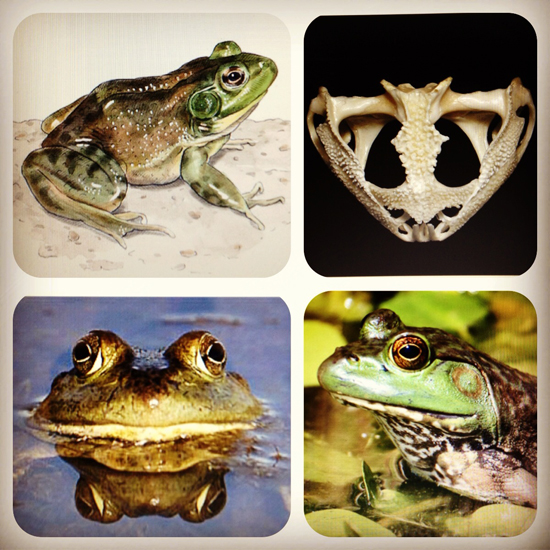
Is the most widely spread “true frog” of North America. Found in almost any body of water, they are aggressive predators, consuming everything from plants to small mammals. It is said that if the Bullfrog can shove it in its mouth… it will be eaten! Starting as eggs they go through metamorphosis in 3 months to 3 years depending on climate. Northern specimens taking longer than those in warm southern states. A frog jumping contest favorite, these amphibians can leap as far as 6 feet in a single bound!
We were so pleased to receive a guest post from Sara E. Viernum, a herpetologist with over 10 years of experience chasing snakes and salamanders around the U.S. When she’s not chasing reptiles and amphibians in the field, Sara is blogging about them on her website The Wandering Herpetologist, which is devoted to all things reptile and amphibian related. She currently resides in San Antonio, Texas, with her wonderful husband and her pet milk snake,Nyarla TheCrawling Chaos. Sara also has a Facebook page.
For two field seasons in 2010 and 2011 I had the pleasure of hunting for aquatic amphibians in the Tillamook State Forest in Western Oregon. I was helping a friend with her graduate research focusing on the effects of fish passable culverts on aquatic amphibians. We spent many, many fun-filled hours crawling around in streams in the forest looking for Pacific giant salamanders (Dicamptodon tenebrosus), Columbia torrent salamanders (Rhyacotriton kezeri), and Pacific tailed frogs (Ascaphus truei).
Male Pacific tailed frog showing his "tail". Photo courtesy Sara Viernum.
The tailed frogs were such interesting amphibians. I had never seen these strange little frogs before we started the stream surveys. The tadpoles have specialized sucker mouths that they use to hold onto the rocks in the fast-flowing currents of the streams. They will also adhere to a collection bucket and your hand. If that’s not strange enough the adult males have a little “tail.” The “tail” is actually an extended cloaca that is used for internal fertilization. The Ascaphus frogs are the only frog species that have internal fertilization.
Pacific tailed froglets showing color variations. Photo courtesy Sara Viernum.
Tailed frogs are members of the Leiopelmatidae family (Tail-wagging frogs). There are only two species in this family found in North America – the Pacific tailed frog and the Rocky Mountain tailed frog (Ascaphus montanus). The family is considered to be one of the most primitive. The frogs cannot vocalize (call) and they do not have an external ear or a middle ear bone. Their closest relatives are the Leiopelma frogs from New Zealand which are also considered to be primitive frogs too.
Pacific tailed frog tadpole suctioned to Sara's hand. Photo courtesy Sara Viernum.
The Pacific tailed frogs could be quite common in some of the streams and were always a treat to find, although it was sometimes difficult to get to tadpoles to let go of your hand.
Pacific tailed frog tadpole showing its sucker mouth. Photo courtesy Sara Viernum.
When was your organization founded? Please tell us a bit about its mission, goals…
Save the Frogs is the first and only public charity devoted to amphibians. It was founded in May 2008. Our mission is to save and protect amphibians, as well as to respect and appreciate nature and wildlife.
I founded Save the Frogs because frogs were rapidly disappearing around the world. About one-third of amphibians are on the verge of extinction. At least 2,000 species are threatened and if nothing is done, will likely go extinct. Most of the work previous to Save the Frogs was done by scientists helping amphibians, but educating the public about the issue is also very important.
Save the Frogs has education programs and works to get laws in place, for example, to get frogs legs out of restaurants, provide schools with alternatives to dissecting frogs, and prevent non-native frogs from being imported.
The biggest thing is environmental education so I created Save the Frogs Day, an event which comes around each year. This April 28th will be the 4th annual Save the Frogs Day and there will be 200 events in 30 countries, which will top last year’s 143 events in 21 countries.
The events bring awareness around the world, especially on that particular day and it receives significant publicity in the media.
What is your educational background and what lead to creating this organization?
I was always interested math and science and studied mechanical engineering as an undergraduate at the University of Virginia, but soon realized I wanted to pursue environmental science. I went back to school to study biology in preparation for graduate school.
I spent a summer in Hawaii volunteering with PhD students who were studying birds. It was then that I knew environmental science was my path. I loved hanging out at streams, so thought about what types of animals live in streams and then found out that frogs were disappearing. I thought frogs would be great to study for my PhD, so I went to Australia and came across Mark Hero in South East Queensland, who became my supervisor. I studied frogs, and the disease, chytrid fungus, which is driving amphibians to extinction.
I finished my PhD, came back to the United States and founded Save the Frogs. I love my work because it’s a combination of communicating awareness, educating the public and science.
What are some challenges you have faced and how did you deal with them?
The first challenge was funding, because we founded in 2008 during the economic recession. Raising funds for a non-profit is hard in the best of times, plus saving frogs is still somewhat of an obscure topic. Most people still don’t know why we should protect frogs.
Save the Frogs works hard on awareness by using the web and speaking to the public directly.
I try to get publicity through newspapers and for-profit corporations involved. Some of them have practices that are harmful to the environment. Many companies when approached don’t necessarily care about what they are doing and only care about making money.
At least one billion frogs are taken out of the environment for use as food in restaurants (frogs legs) and farm-raised frogs carry diseases and if you approach restaurants and ask them to stop selling them, they only see it as a monetary loss.
I have and will continue to approach tech firms in nearby in Silicon Valley for funding. Many of them have no environmental program.
How is climate change effecting amphibians?
Climate change is a huge problem, so it’s good that it gets a lot of attention. We need more people in the government looking seriously at climate change and what to do about it. It’s very important to amphibians because they are very connected to precipitation levels.
“Amphibian” means two lives, one on land and one in the water. Frogs either lay their eggs in water or in leaf litter and the ones who are not in the water are in cloud forests in tropical countries. As the temperature rises, the cloud level rises and the leaf litter dries up. This means that the frogs must continually move up and eventually will run out of space. Many of the frog species live on a particular mountain and only that mountain, so if something happens to that species it can go extinct.
It’s not just tropical forests that are in trouble, Yellowstone National Park in the U.S. has had droughts. About one fourth of the ponds have started to dry up and many frog species are on the decline.
Save the Frogs had five posters up in airports around the country and the one in O’Hare is still up and has been seen by hundreds of thousands of people.
How do you reach your targeted audience? Is it through your website, advertising or social media or another route? Which is most effective and why?
The best way I can reach people is through our Save the Frogs website which has helped make it a worldwide organization. Our e-newsletter is also a great tool because whenever we need help and send it out, we can reach tens of thousands of people. We recently sent out an email with a free download of “The Wild World of Frogs” and it got 40,000 downloads in the first day! Many of those downloads were from friends forwarding the newsletter to their friends.
We create a variety of flyers people can post around their towns. Most things we do are free and up on our website and if you give people the tools they will help spread the word.
Some of the other ways we reach people is through our Facebook page with frequent updates, as well as through Twitter.
I give live presentations and did 65 this year. I believe you can get more people involved by interacting with them face-to-face. I’m trying to get more teachers involved and Save the Frogs Day on April 28 is a great way and to get lots of people talking about it.
What can people do to help?
There are lots of ways to help Save the Frogs! Our website has over 250 pages of information. I feel that educating yourself on the issues is the first step and then subscribing to our newsletter to stay informed.
Learning how you can change your ecological footprint is a great way to help. Everything you do effects the environment.
There are lots of ways to volunteer and many things can be done through the internet so you can be from anywhere! There is a form on our website you can fill out. We have various campaigns and also need help writing letters to the government, for example, the campaign to ban Atrazine. Visit our “take action” page.
Save the Frogs is a 5013C public charity and has a wish list of things we need which is also posted on our website.
Tell us about your events around the world and some of the campaigns you have started.
Save the Frogs is an international organization because amphibians are disappearing all over the world. A few years ago I was asked down to Panama to give a five day talk on molecular biology and also taught the scientists there how to detect the chytrid fungus disease. If you cannot detect the disease, how can you do any research on it. The materials and information is available on the Save the Frogs website. “QPC” is the technique for detecting the disease and the materials have been downloaded by scientists in over 30 countries.
Last year I got invited to Korea and was the representative for the 1st Amphibian International Symposium. I traveled around Korea for 10 days doing environmental work. Seeing what types of problems they had, coming up with solutions and giving presentations to communities, groups and schools. We have applied for a $50,000 grant that would go to helping Korea’s amphibians.
In September, 2011 I spent a month in Ghana and helped them start Save the Frogs Ghana. We are registering it as a NGO with the government of Ghana. It will be an independent Save the Frogs working on it’s own. We have written a proposal to help the Squeaker Frog (Arthroleptidae: Arthroleptis) and also to make the Atewa Hills a national park. We are trying to save the Togo Slippery Frog (Conraua derooi) which lives in only two streams and are threatened by mining. They are a fully aquatic frog and swim as fast as a fish.
What is in the works for the future?
Save the Frogs is coming to New York, New Jersey and Connecticut in March 2012. I will be looking for schools and community groups for presentations.
Save the Frogs Day is April 28th and we have a 5k race planned in Seattle and another event in San Francisco. There will be “Ban Atrazine” rallies and we will be raising awareness about it.
New campaigns include a petition to Governor Gerry Brown to stop the importation of American Bullfrogs. About 3 million are imported to the state of California each year. Being native to the east coast, when they come to California, they eat the native wildlife and they are primarily for pets, dissection and frogs legs in restaurants. They carry the chytrid fungus so are spreading the disease.
Nathan’s Famous is now selling frogs legs and I want to get this to stop. The executive and CEOs have refused to address the issue. They need to take some environmental responsibility.
Helping Save the Frogs Ghana
Ghana is a poor country and frogs are in trouble because of illegal foresting. There are now programs in place to teach mushroom farming and bee keeping which can change a family’s life. We will be working to get the Atewa Hills a national park.
To learn more about Save the Frogs visit the links below:
Researchers at Oregon State University have discovered a freshwater organism that might help in fighting the chytrid fungus, which is a principal cause for the worldwide amphibian decline. A freshwater species of zooplankton, called Daphnia magna, could provide a tool for biological control of the deadly fungus whose impact, one researcher has called “the most spectacular loss of vertebrate biodiversity due to disease in recorded history.”
Daphnia magna is a variety of water fleas of the genus Daphnia, some species of which are commonly used as food for aquarium fish. It was known that the zooplankton could devour some types of fungi. Oregon researchers wanted to find out whether Daphnia magna could also consume the chytrid fungus that has been devastating amphibian populations worldwide, including Colorado’s endangered boreal toad.
Through extensive research, scientists confirmed that Daphnia magna could consume the free swimming spores of the fungal pathogen. According to lead researcher Julia Buck, an OSU doctoral student in zoology, in an Oregon State University press release:
We feel that biological control offers the best chance to control this fungal disease, and now we have a good candidate for that. Efforts to eradicate this disease have been unsuccessful, but so far no one has attempted biocontrol of the chytrid fungus. That may be the way to go.
Now scientists need to conduct field studies to confirm the zooplankton’s effectiveness in a natural setting. The OSU scientists have found that Daphnia inhabits amphibian breeding sites where chytrid transmission occurs and may be able to stem the unprecedented population declines and extinctions.
For background on the chytrid fungus, please see the video below that we found on the Save the Frogs site, produced by the National Science Foundation:
The Oregon State University research was reported in the journal Biodiversity and Conservation, and was supported by the National Science Foundation. Click here for the full report.
This summer, my family and I have been visiting public gardens in the New York area and have noticed something in each one we’ve visited—drowned frogs in the gardens’ fountains and pools. We thought we’d repeat a blog post from a couple of years ago about this problem. It has such an easy solution: frogs just need a way out of the pools. I watched some frogs trying to climb out of the stone pools and they weren’t able to get out. They need a ramp, a step, or some other way to escape. Here’s one way that frogs can escape: The Froglog.
A couple of summers ago, we received a wonderful photograph taken by Mary Lascelles for our photo contest of a frog (whom she named Fritz) who hung out on the filter line in her pool sunning himself. Luckily, Fritz never fell in the pool.
Unfortunately many frogs do fall in pools and are poisoned by chlorine, which is absorbed into their bloodstream through their permeable skin. Recently on the Mother Nature Network blog, I read about a new invention, called a Froglog, that is an escape ramp that helps frogs and other small animals escape from pools.
The froglog was created by Rich Mason, a wildlilfe biologist with the U.S. Fish and Wildlife Service, who was disturbed that so many frogs and other animals were dying in pools. The froglog is a thick foam tile with angled edges that allow frogs to climb out of the pool. The froglog can also be used in hot tubs, spas, fountains, and backyard ponds.
As Mason writes on his website, due to suburban sprawl, pools are now often built close to the natural habitats of amphibians. He mentions a friend with a pool in Maryland who found over 50 animals trapped in his pool in one night.
Check out this video of frogs and turtles using the froglog escape ramp. And if you have a pool, fountain, etc… and live in an area with lots of wildlife, definitely consider getting a froglog!
This summer we’d like to encourage you to get out and photograph amphibians while on vacation or near home, even in your own backyard! The beauty of photographing frogs and other amphibians is that you don’t have to go on a safari or travel to someplace exotic to photograph them.
Here are a few tips from the book Frogs: A Chorus of Colors by John and Deborah Behler, which has a chapter on photographing these well-camouflaged creatures:
• Try to learn about the animal first. What is its habitat? When are they active?
• Walk slowly and stop frequently [it helps to have someone with you who is less than 3 feet tall and has sharp eyes]. Frogs and toads blend in so well that they are hard to find. Be alert for subtle movements.
• In summer, you might find the sit-and-wait frog predators hanging out on the edges of ponds and lakes.
• Be aware of the position of the sun. Avoid taking pictures at midday on bright sunny days. In the morning, face east and it will keep sunlight from coming into your lens and washing out your photos.
• Don’t necessarily put the subject in the middle of the photo. Keep the whole animal in the photo, but compose the picture so the background tells a story.
• Bracket your photos, i.e., take the same shot with different settings. Also, try taking a flash photo. Without a flash, animals in photos may look lifeless and poorly lighted.
• Try to be on the same level as your subject.
• State parks, bird sanctuaries, and wildlife refuges are good places to find amphibians.
You don’t need a fancy camera to get interesting shots. I took this photo of a spring peeper in low light with a Kodak EasyShare camera on the Flower Setting (might be called “close up” on your camera). When we were traveling in Virginia, my husband stopped the car so that we could listen to the peepers. Although peepers are often heard with their distinct high-pitched “peeps,” they are seldom seen. My son spotted the peeper below, but it took my husband and I about five minutes before we were able to see the inch-long and extremely well-camouflaged frog. Once we spotted it, the frog sat stock still for a few minutes to allow all three of us to behave like amphibian paparazzi (we took a dozen pictures before the frog had had enough and hopped off).
I think this is one of the reasons I enjoy photographing frogs: they have a survival behavior that causes them to freeze when they sense danger, in order to avoid detection from predators (unlike mammals like rabbits, deer etc, which will hop or run off long before you’ve even focused) so that it’s possible to get some great pictures of them.
spring peeper, photo by Mary Jo Rhodes
For inspiration, we recommend taking a look at the book Frog: A Photographic Portrait, a gorgeous collection of photographs by wildlife photographer Thomas Marent, who traveled to rainforests all over the world to photograph unusual amphibians. As he says, “The variety of colors, shapes, and sounds of frogs is truly spectacular, and a wildlife photographer’s dream….!”