09/2/14

Hawaii’s Inhumane Frog Policy

I received yet another call from someone distressed about coqui tree frogs on her property. No, she wasn’t wanting to find out how to kill the frogs. She was trying to find out how to keep them and resist aggressive neighbors wanting the frogs destroyed.

For many people in Hawaii, as in Puerto Rico, the coqui frog is considered an adorable creature, singing at night and improving the environment by eating insect pests. They can get loud in large numbers, but for those who enjoy the sounds of wildlife, the coqui chirp is soothing and creates a white noise that aids sleep. 

However, the Hawaiian government has passed laws to vilify coqui frogs as a noisy environmental menace, making it illegal to “harbor” or transport coquis within the state. According to the law, coquis frogs are pests by definition, and anyone enjoying them does so at his own peril. Millions of dollars have been spent trying to stop the spread of the frogs, which now reside happily on the Big Island’s east side and in limited areas of the other islands.

Of course, if the coqui frogs were native to Hawaii, they would be protected, not killed. The sound would be appreciated and promoted, as it is in Puerto Rico.
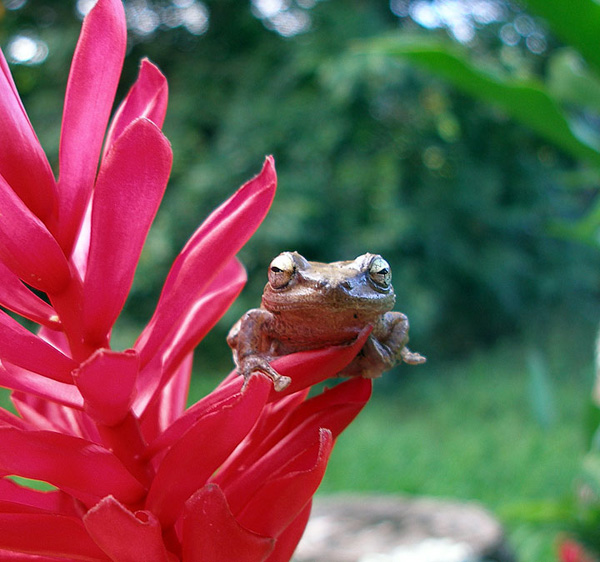
coqui frog in Hawaii

However, in today’s Hawaii, only native species are valued. Introduced species are now regarded as illegal aliens, and harboring these aliens is against the law. Laws defining the coqui as a “pest” allow the cruel slaughter of these tiny, harmless creatures, bypassing humane treatment laws.

The Good Shepherd Foundation, of which I am the director, believes that cruelty to animals is unacceptable, regardless of whether the animals are native or not. In 2001 we started a program to counter the anti-coqui propaganda, called CHIRP, or the Coqui Hawaiian Integration and Reeducation Project. Acceptance, we believe, is better than an endless environmental war against the frogs.

Over the years we have been contacted by many residents who found the frogs desirable on their property, but who were being harassed by neighbors who did not yet have the frogs and wanted them eradicated. This meant having one’s property sprayed with citric acid, which kills plants as well as coquis, lizards, insects, and other non-target species. The acid burns the victims to death.

Anti-coqui hysteria has made people fearful of admitting they like the coquis, faced with the unfortunate choices of harassment, or letting eradicators poison their property.

Some residents would like to remove the coquis to avoid the drama, but don’t want to kill the coquis in the process. These humane-minded people are faced with another dilemma. Moving coquis is a crime. The government has made it so people can only kill coquis, either with citric acid or by cooking or freezing the live frogs. You can’t legally catch the frogs and release them somewhere else where there are other frogs.

This means the Hawaiian government has made it illegal to treat the coquis humanely. It forces residents to either be cruel to the frogs, or to break the law and illegally release the frogs elsewhere, which many people do.

The most recent phone call was from a woman who wanted to save the lone coqui on her property from a certain death. A neighbor heard the frog and reported it to the homeowner’s association, which was dispatching an eradicator right away. The neighbor also complained that this same woman was feeding non-native birds, and threatened to have the birds shot.

For those who love wildlife, Hawaii is no longer a paradise. Species are not valued for their beauty and other positive qualities, or for the biological diversity they bring to these volcanic islands. Instead, they are valued solely for being “native,” and are killed solely for being introduced.

It is a war on wildlife. Property owners, residents, and visitors who value wildlife for what it is, regardless of whether or not it was introduced, are victims of this war.

For more, see our website, www.HawaiianCoqui.org.

Guest post: Sydney Ross Singer is a medical anthropologist, author, and director of the Good Shepherd Foundation.  He lives on a coqui frog sanctuary with his wife and son on the Big island of Hawaii.

08/22/14

Recycling: Why Is It So Hard for Some?

Recycle graphic from psdgraphicsYesterday I had an argument with someone I know. She was mixing all the trash into one bag to put out on the street. No matter what I said, she refused to separate the trash. Why is it so hard for some people to follow the rules (the law)… not just because the city tells us to, but because it’s right for our community and our planet.

My community has a trash problem, city wide actually. The street cleaners (physical people) are currently at a minimum. I see someone maybe once a week and that’s not enough to pick up after citizens who believe there is someone walking directly behind them ready and waiting for their chip bag, pizza plate or empty soda can. What kind of parent doesn’t teach their children to respect others, our community, and has those same bad habits? Store owners don’t bother to come outside and pick up the trash right outside their door.

And… we’ve got another problem (worse than regular trash, if you know what I mean) with the homeless who are living on the streets, and don’t get me started on the dog poop.

Lately, the Riverview Neighborhood Association has pushed back against this with their own “clean-up” project, one street at a time. A very impressive initiative, which more neighborhood associations need to implement.

The City of Jersey City and Sustainable JC have hosted conferences in City Hall such as the Zero-Waste Conference, but of course the people who attend (like me) already care about this issue, so how can we reach the people we need to?

Anyway, in case you’re not sure what the “Trash/Recycling” law is, here in Hudson County, here are some details via the Hudson County Improvement Authority — http://hcia.org Visit their website, because there is a lot more information including what you cannot recycle!

Solid Waste Management
Each and every day, Hudson County residents generate more than 1,500 tons of solid waste! Much of this can be harmful to our environment if disposed of improperly. Making certain that this trash is disposed of in an environmentally sound and cost-effective manner is the highest priority for the HCIA and its Division of Solid Waste.

Recycling
In Hudson County, recycling has become an important method of waste management. Materials that were once thought to be unrecyclable are now being commonly recycled. However, there are still some materials that can not be recycled and those that can be need to be prepared correctly for recycling so that they can be reprocessed into new products.

Paper

Paper and paper products comprise approximately 32% of the waste stream in Hudson County. There are many different types of paper:

* Corrugated Cardboard
* Chipboard & Paperboard
* Mixed Paper
* Phone Books
* Hi-Grade Office & Computer Paper

Plastics
Plastics can be very mysterious because each type is made up of different chemical components. Therefore, it is essential that only similar types get recycled together.

For Better Recycling
Sorting different types of plastic is essential to producing high quality recycled products. Check with your local recycling coordinator as to which types of plastics are collected by your municipality.

Glass
Recycle only glass bottles and jars from food, beverages and medicine. Do not recycle light bulbs, glassware, ceramics and window glass, which are each made of different ingredients, and by different processes.

Aluminum, Tin and Steel Cans
Typically, the only kind of aluminum your town wants set out for curbside collection is aluminum beverage cans. You can test if a can is aluminum or steel by using a magnet: a magnet won’t stick to aluminum. Unless indicated differently, glass, aluminum, steel and tin cans can be commingled for collection.

08/1/14

Tadpoles in Maine Pond Die from Ranavirus

An estimated 200,000 Wood Frog (Lithobates sylvaticus) Tadpoles in a local pond in Maine died within a few days (in 2013) from most-likely a ranavirus. A paper was recently published in Herpetological Review that is co-authored by Nathaniel Wheelwright, a biologist at Bowdoin College, along with the University of Tennessee.

“The dead tadpoles had signs of hemorrhaging in their legs and around their throats, and many had skin that was sloughing off their bodies”, Wheelwright said.

Wheelwright has monitored the pond for close to 30 years and said it was quite surprising. Usually there are 50-100,000 tadpoles and only 1000 may live to become adult frogs. But for all to die, very unusual. They did notice there were no leeches present.

There are other species who can carry the ranavirus, such as green frogs, bullfrogs, painted turtles and spotted salamanders* (*who were found in the pond and showed signs of suffering from the virus also.)

Here’s a video from Bowdoin College with biology professor, Nat Wheelwright talking about the tadpoles:

The good news is that this past Spring showed healthy tadpoles and frogs and no sign of any issues.

Do you think this was caused by pesticides and/or climate change? Too many tadpoles crowded together?
___________________________________________________________________

The differences between Chyrid Fungus and Ranavirus are:

Chyrid is a fungus and infects individual frogs who suffer damage to their skin. Once infected it impairs respiration and the frog dies. It has been devastating amphibian populations around the world.

Ranaviruses infect insects, fish, amphibians and turtles and infect larvae or recently metamorphosed individuals.

07/9/14

Eco-Interview: Allison Green, Painting Nature – Jersey City Artist

Frogs Are Green founder, Susan Newman interviews Allison Green about her large-scale, exquisite paintings of nature. Here’s what Allison shares with us:

Allison Green, Jersey City Fine Artist in her Studio

It’s hard to say exactly why I paint nature – but I am sure that it roots from my childhood life in Pennsylvania, where I grew up in a house on the perimeter of a lush forest. Memories of a childhood which revolved around nature are deep within me, especially today, as I have been living in the city for the last 20 years. Sometimes I wonder if I paint nature because I long for those lush forests of my childhood, or if it is the stories in those trees which still resonate so deep with in that I feel the need to let them out. Or, maybe it’s a combination of both.

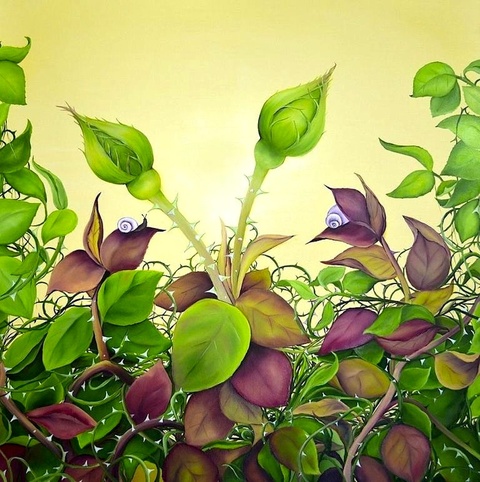
April Roses, 2013 - Oil on Canvas, 48" x 48"

April Roses, 2013 – Oil on Canvas, 48″ x 48″

These days, while I still love exploring vast forest and other pristine terrain, I have become most inspired  by urban nature – from cultivated gardens like the High Line and the New York Botanical Garden, to the wildest of plant life that seems to sprout everywhere throughout the city and streets.

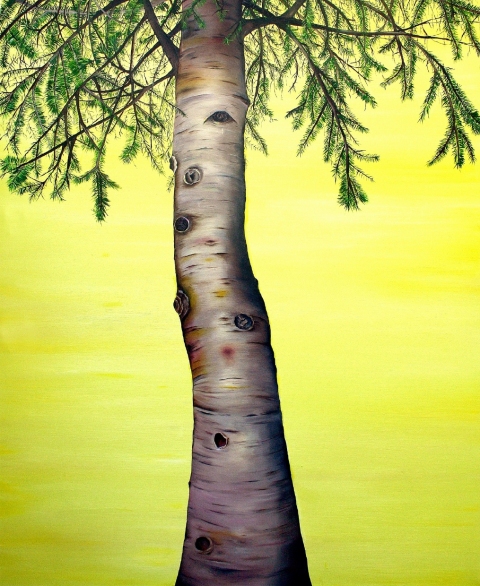
My inspiration often comes from the smallest details of a plant, such as the complex anatomy of a tiny, overlooked weed, the gnarled bark on an old, giant tree in the park, or those resilient vines growing up the sides of buildings in the summertime.

Eve, 2010 - Oil on Canvas, 30" x 24"

Eve, 2010 – Oil on Canvas, 30″ x 24″

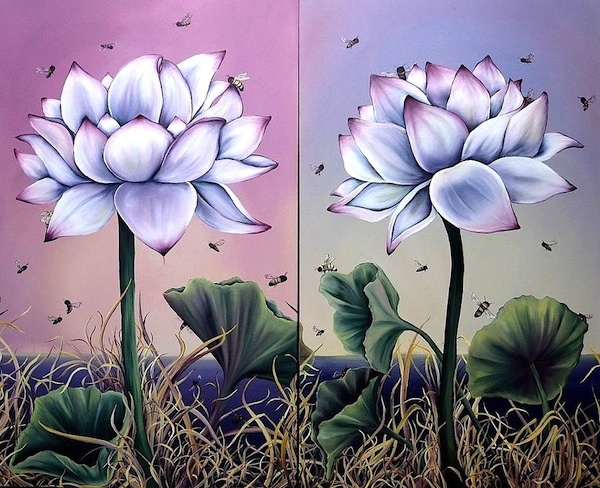
In my most recent paintings, I’ve also become fascinated with the delicate and complex reproductive relationships between plants and insects. A swarm of bees pollinating a pair of desirable lotus flowers, while mating snails hide within an ever-evolving rose bush are examples of new imagery in which I seek to capture the magical and surreal natural world.

In addition, I’ve become fascinated by the way all life forms change, evolve and become something very different along the way. “Everything Changes”, my latest series, documents different phases in a plant’s life cycle, along with depicting insect/plant relationships.

Pollinate Me (lotus flowers with pollinating bees) 2014, Oil on Canvas, 60"x72"

Pollinate Me (lotus flowers with pollinating bees) 2014, Oil on Canvas, 60″x72″

Nature is such an amazing, endless source of inspiration. And as humans are putting it in jeopardy in so many different ways, it has become an even more important subject in my mind. Whether it be to find beauty in a simple weed, cherish a neighborhood tree, or to realize the perfection of most common little bug,  I hope that my work can inspire someone to look at plant life and all of nature in a new way every day.

— Allison Green, Jersey City Artist


Lovers, 2010 - Oil on Canvas, 60" x 48"

Lovers, 2010 – Oil on Canvas, 60″ x 48″

Currently Allison resides and works in downtown Jersey City, where she creates large-scale oil paintings. Her first solo exhibition, “Deeply Rooted”, opened in March 2011 at Susan Eley Fine Art in New York City. A second solo show at SEFA, “Entwined”, opened in September 2012 and features a fully illustrated catalog with an essay by Lilly Wei. Green’s work is now included in the Brooklyn Museum Elizabeth Sackler Feminist Art Base, and her paintings were recently exhibited at PULSE NY in spring 2013.

Green holds a BA from the University of Maryland with a concentration in Fine Art and Women’s Studies. She also studied at Studio Art Centers International (SACI) in Florence, Italy in 1995.

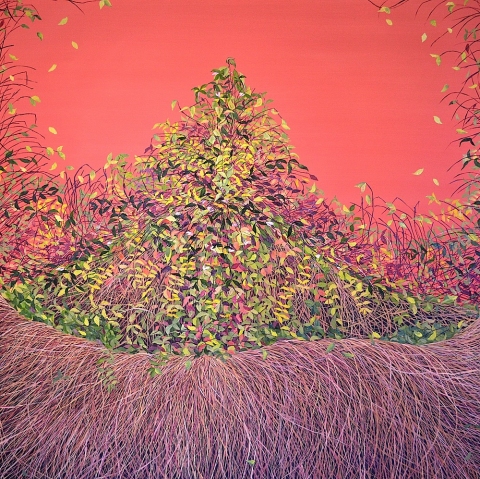
Sienna Thicket (Thicket #4) 2011, - Oil on Canvas, 48" x 48"

Sienna Thicket (Thicket #4) 2011, – Oil on Canvas, 48″ x 48″


07/7/14

Pond Maintenance: Tips for Keeping Wildlife At Your Pond

Ponds are an incredible edition to any garden and are perfect for attracting a whole range of wildlife; from the fish you may have purchased to the frogs, toads and newts you hope might come and visit. Ponds are a delicate ecosystem; the perfect blend of fish, oxygenating marginal plants and natural wildlife is sometimes hard to get right, but one of the things that can definitely help is maintaining your pond properly.

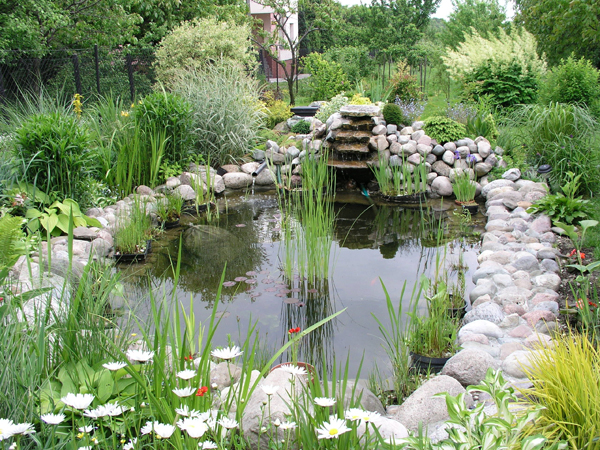
garden pond lush green and beautiful

All ponds need regular maintenance to prevent them from turning into glorified bogs. Regular cleaning is a good idea to prevent silting up.  Autumn is generally the best time for cleaning as much of the wildlife is less active or beginning to hibernate. Firstly, it is important to create a holding tank for your fish and other creatures and also your deep water plants using some of the pond water. Marginal plants should be alright as long as they are kept moist. The pond needs to be drained and the fish and creatures removed carefully and put into the tank as they become visible. Any decaying plant material may contain smaller creatures so place to the side of the pond so they can make their way back.

Remove any silt from the bottom of the pond. Most of this can be added to the garden to improve soil structure for your plants but do keep some in hand for replacing at the bottom of the pond.  This is important for maintaining an ecosystem for smaller organisms which are beneficial for the pond.

The next step is to clean the liner with a brush and then refill the pond, preferably using rainwater collected from a water butt. Finally return the fish and other creatures and also the deep water plants to the pond.

After cleaning it can take a while for the pond to recover, which is the reason an autumn cleaning is generally preferred.

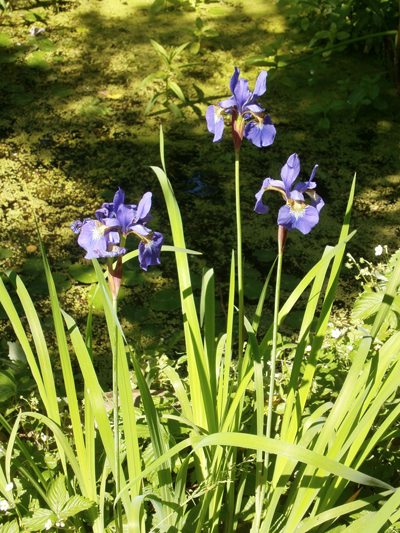
Water Iris surrounding pond

Another good practice to get into is maintaining your pond pump efficiently. If your pond does not have a pump they are readily available from retailers such as Swell UK in the UK.  If you notice the pump is going slower or has stopped completely it might be that the pump is just clogged or suffering from a build-up of blanket weed. Alternatively there may be a problem with the electrics and cabling. The first thing to check is the electricity.  Ideally you should have a circuit breaker and a switchbox.  The circuit breaker will trip if there is a problem with the electrics; and the switchbox will isolate the different cables on the off chance you have accidently cut through a wire.  If you have both of these you can diagnose the problem at the pump.

This problem is relatively easy to remedy; you can usually remove things easily enough from a pump.  Pumps are relatively easy to take apart and put together again.  If the pump looks green, then you have a problem with blanket weed, otherwise you need to look for the impeller (which is where the water from the pond is sucked in).  This is where the blockages will be – use a screwdriver to clear out the cavity. Pond pumps need regular maintenance if you do not look after your pond properly.

And there you have it; a happy clean pond and a suitable working pond pump make for the perfect habitat for fish, frogs and other wildlife.

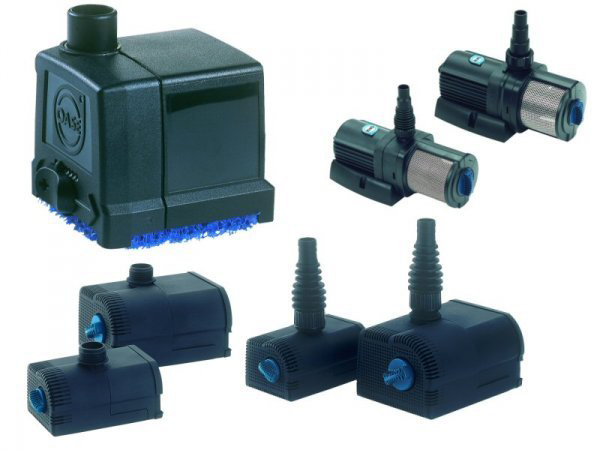
Oase Pond Pumps


– Guest post by Chris Plum, pond and garden products advisor

07/4/14

Monet’s Garden and Frogs

Ever since I can remember having an appreciation for art, I was a fan of Claude Monet. A few weeks ago I was watching the PBS program NYC Arts and one of the reports was about Monet’s Waterlilies at MOMA. I can’t even begin to tell you how many times I’ve seen those magnificent paintings. But it wasn’t until that evening that I made the Frog Connection. All of a sudden I thought, with all those 100s of paintings created in Giverny Garden, did Monet ever paint a frog?

After the program was over, I went on the internet and searched “Did Monet ever paint a frog?” What came up mesmerized me. Pages and links to children’s books on this very topic. After reading and studying many pages it’s hard to know the truth, especially given that Monet was an impressionist painter and so a green dab of paint might be misconstrued as a frog.

I read three of the children’s books and I’d like to share them with you:

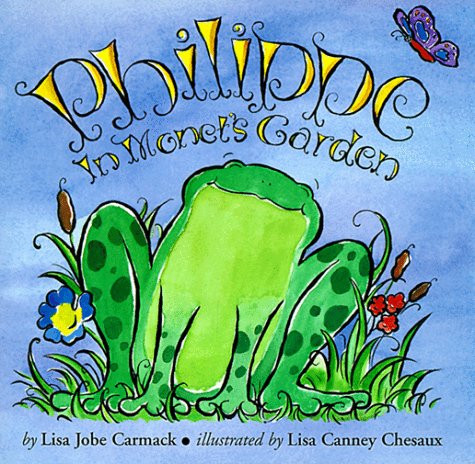
Philippe in Monet's Garden

Philippe in Monet’s Garden
by Lisa Jobe Carmack and illustrated by Lisa Canney Chesaux

A charming story about a frog named Philippe, who just happens to live in France and just happens to have very large and long legs. As frog lovers, I’m sure you can imagine his potentially scary destiny to a local restaurant with all the frog hunters out there. Two of his frog friends get nabbed and so he hops away and away until he comes upon Giverny Garden where a sign is posted: No Frog Hunting! He’s safe! In he hops and Monet welcomes him, admires his large and beautiful legs and Philippe lives his life in that beautiful place with lots of bugs to eat and no fear. He may even be seen in one of the pictures?

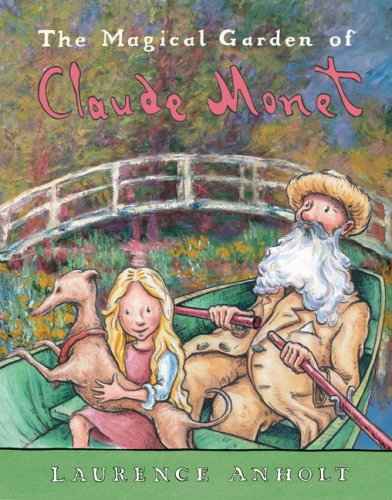
The Magical Garden of Claude Monet

The Magical Garden of Claude Monet
by Laurence Anholt

This is more of an adventure story. A young girl and her pet dog are feeling antsy in their family’s urban dwelling, while the mother is busy painting a picture. But the mother reassures Julie that as soon as she’s finished, they will go on an exciting adventure to a magical place. They board the train to travel to Monet’s garden at Giverny and it’s an afternoon of marvel and discovery. Beautiful watercolor illustrations throughout the book. Unfortunately, no mention of frogs.

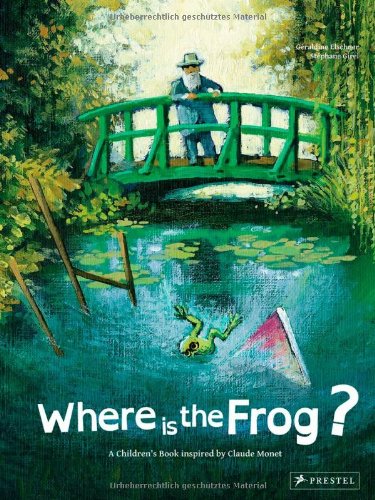
Where is the frog?

Where is the Frog?
by Geraldine Elschner and Stephanie Girel

A children’s book inspired by Claude Monet

As you might imagine, this one was my favorite! The illustrations throughout are styled after Monet and the story is adorable. In this story we have a little female frog named Antoinette who only wants to be the subject of Monet’s efforts. She moves and poses and when he walks away, she hops up to have a look at the painting and realizes that she was a green frog sitting on a green lily pad. Oh no, that’s why there is no frog in the picture. So the next day she poses hanging from a vine or within some flowers, and hooray, she’s depicted in the picture. She gets so excited she knocks the painting, easel, materials and herself into the water. Alas, still no picture with a frog in it!

— Susan Newman, founder Frogs Are Green


Water Lilies, 1919, by Claude Monet - Metropolitan Museum of Art, New York City

Water Lilies, 1919, by Claude Monet – Metropolitan Museum of Art, New York City

About Claude Monet’s Garden at Giverny (Wikipedia):

Claude Monet noticed the village of Giverny while looking out of a train window. He made up his mind to move there and rented a house and the area surrounding it. In 1890 he had enough money to buy the house and land outright and set out to create the magnificent gardens he wanted to paint. Some of his most famous paintings were of his garden in Giverny, famous for its rectangular Clos normand, with archways of climbing plants entwined around colored shrubs, and the water garden, formed by a tributary to the Epte, with the Japanese bridge, the pond with the water lily, the wisterias and the azaleas.

Monet lived in the house with its famous pink crushed brick façade from 1883 until his death in 1926. He and many members of his family are interred in the village cemetery.


Water Lilies (or Nymphéas) is a series of approximately 250 oil paintings by French Impressionist Claude Monet (1840–1926). The paintings depict Monet’s flower garden at Giverny and were the main focus of Monet’s artistic production during the last thirty years of his life. Many of the works were painted while Monet suffered from cataracts.[1]