04/6/15

The Benefits of Frogs in Your Garden

Frogs and toads, just like so many other animal species, are suffering a decline in numbers. This is due to environmental problems, climate change and human factors and show that the changes we are seeing in the environment are signs that something is wrong.

What many people should realize is that frogs need to be viewed as an important part of the ecosystem.
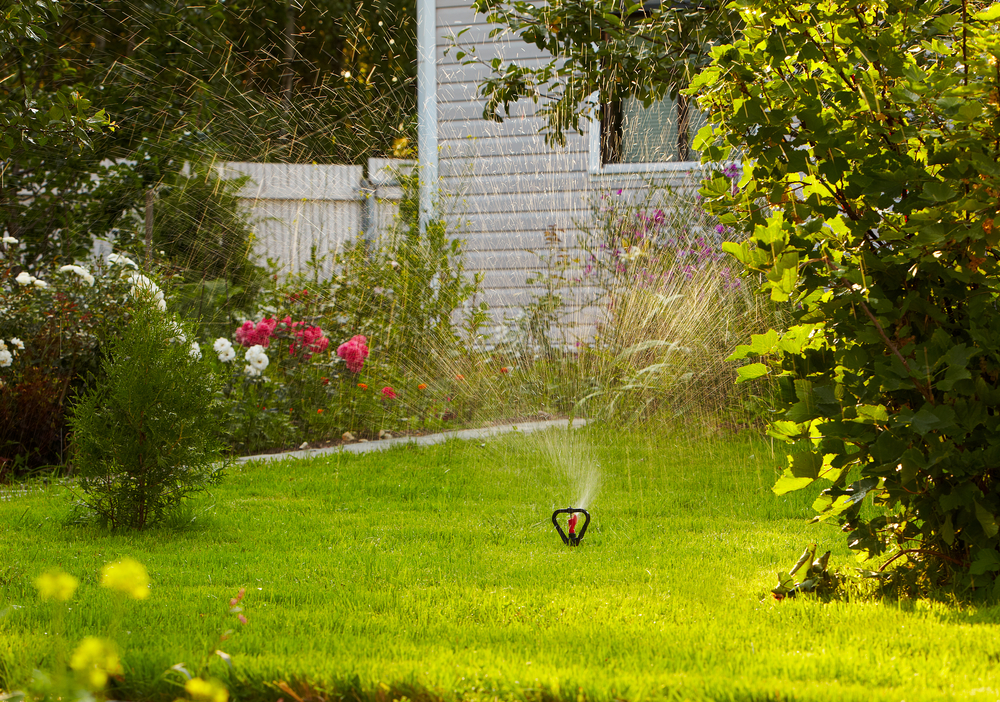
The Benefits of Frogs in Your Garden

Frogs and toads are not only very beautiful and diverse (Frogs per Wikipedia – approximately 4,800 species); they can also prove to be very beneficial for your garden.

  • Every ecosystem is comprised of multiple species that create a chain. It is what keeps the balance in nature and what maintains life as we know it. As such, frogs and toads have their place under the sun and should be protected. This is the reason why you will do very well to ensure that frogs can find shelter in your garden. If you provide the right conditions and features for these amphibian creatures, they should appear.
  • Frogs are good bioindicators. There is a lot that you can learn from the frogs in your garden. Frogs can show you that something is wrong in the area, or if they are happily breeding and living in the area, then everything should be okay. If you are dedicated and want to have a perfect garden, you can use the indications from frogs to know if the conditions in your garden are good, or if the frogs that used to dwell there suddenly go missing, you will know there is a disturbance.
  • Pest control – frogs are amazing at cleaning the garden from harmful insects. If you are having such problems, you can easily eliminate them by introducing frogs among your plants. A single frog can eat over 100 insects, such as caterpillars, sow bugs and cutworms and more. These can destroy your entire garden if left unchecked. With frogs around, you won’t need to use harmful pesticides, either.

Toads and frogs can be one of the best solutions for your garden. Not only will you have a garden safe of bugs and insects, but you will also have very pleasant amphibians hopping around.
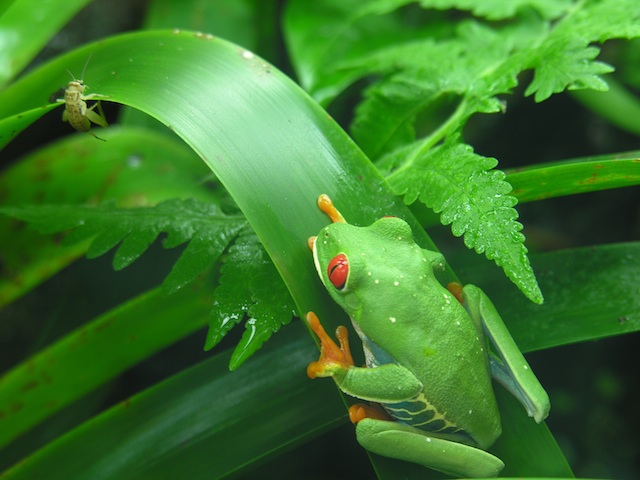
Tree Frog and Bug from EarthRangers.com

Tree Frog and Bug from EarthRangers.com

Guest post by Ella Andrews granted on behalf of: an excellent cleaning in Ruislip.
03/22/15

The Young Environmental Artist

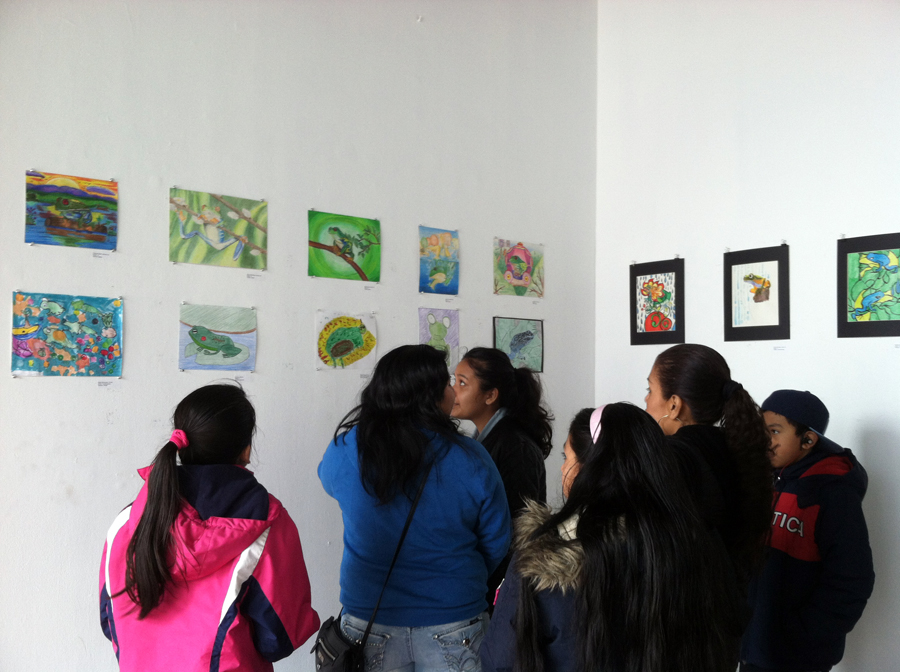
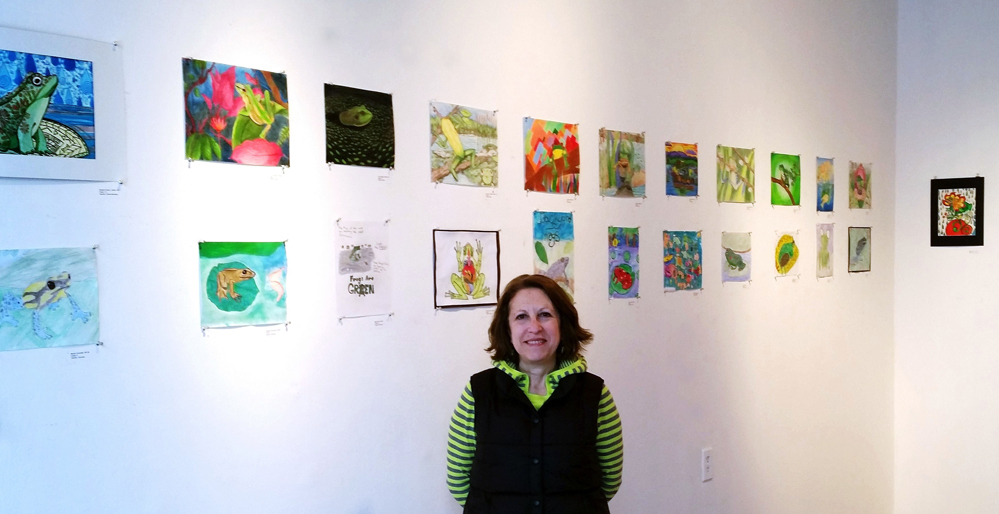
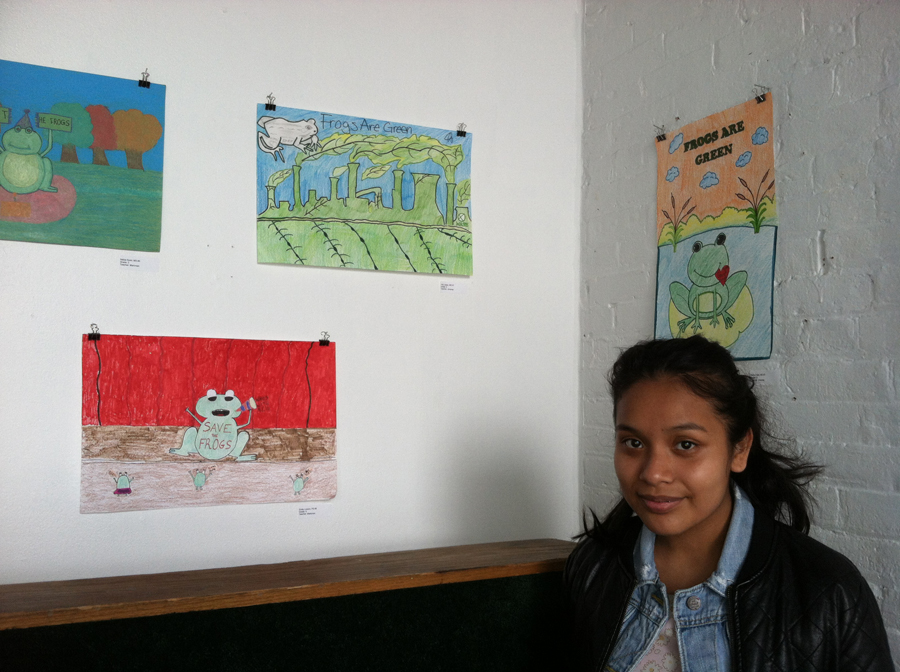
The young artist’s family and friends step out the cab and walk into the gallery one by one, parents and children of different ages. They begin looking and move down the wall, admiring the variety of each artwork. The young artist turns and as she walks across the gallery I see a shy smile across her lips. Yes, she has spotted her own artwork and moves closer to see it. I ask her if I can take her photograph with her artwork and she agrees. Her family takes pictures also.

young environmental artist at 58 Gallery on Coles Street in Jersey City

We have a conversation about whether she had a lesson in school about frogs and the environment before she did her artwork (statement) on pollution. She tells me that she did some research but just created this based on her own imagination.

It’s a wonderful and sometimes strange feeling when one sees their artwork hanging on a gallery wall. For an artist, it’s what we all dream of. Visibility and the opportunity to share what we think.

As we’re talking, I see the parents and the other children moving around the gallery discussing the other works and taking photographs that will hopefully be shared with the extended family and perhaps on social media.

family admires environmental and frog art at 58 Gallery in Jersey City

The youngest of the children takes me around to show her favorite pictures and why. She’s about 4 years old and drawn to the cutest and friendliest of the pictures.

They all say how much they enjoyed the exhibition and will be sure to do more frog art next Fall.

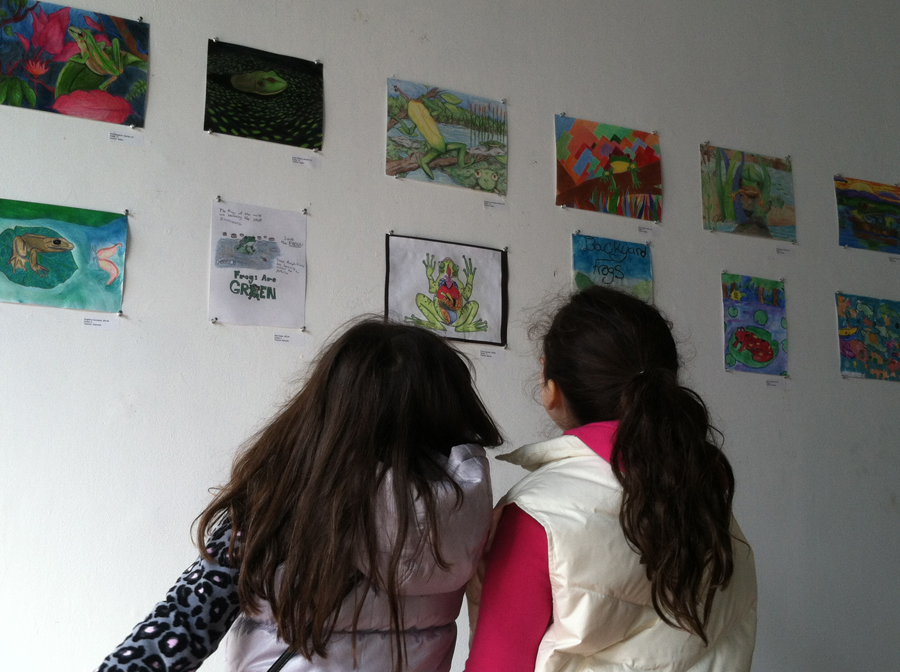
Two young girls admire frog art

During the afternoon parents and children come by to see the student artworks but some people walk through the gallery on their way to a separate destination and do not even look at the walls, as if there is nothing there.

This baffles me and makes me wonder if there are some artists who think only their art is what’s important. Isn’t being an artist about appreciating self-expression, both your own and others?

Do seasoned artists think that because they are at a certain level of success, a young artist’s vision is of no consequence? Aren’t their artworks worth a look?

I believe that every person has the right to be seen and heard.

Having an appreciation of the arts (in its various forms, from dance and opera, to fine art and yes student frog artwork too) means stepping out of your own little world of self-expression and seeing what others have to say too.

Susan Newman, founder of Frogs Are Green hosted original Jersey City student frog art exhibit at 58 Gallery.

02/27/15

Chytrid Fungus is Found in Madagascar

The entire amphibian class is currently afflicted by a global pandemic that is accelerating extinction at an alarming rate. Until now, a few islands like Madagascar were thought not to have been affected. However, an analysis of the latest series of tests shows that the chytrid fungus also poses a threat to amphibians in Madagascar. “This is sad news for herpetologists around the world,” says Dr. Dirk Schmeller of the UFZ, who was involved in analyzing the samples and has, together with Elodie Courtois, detected Bd in samples from Madagascar collected in 2010. “Firstly, it means that an island that is home to a particularly high number of amphibian species is now at risk. Several hundred species live only on this island. And, secondly, if the pathogen has managed to reach such a secluded island, it can and will occur everywhere.”

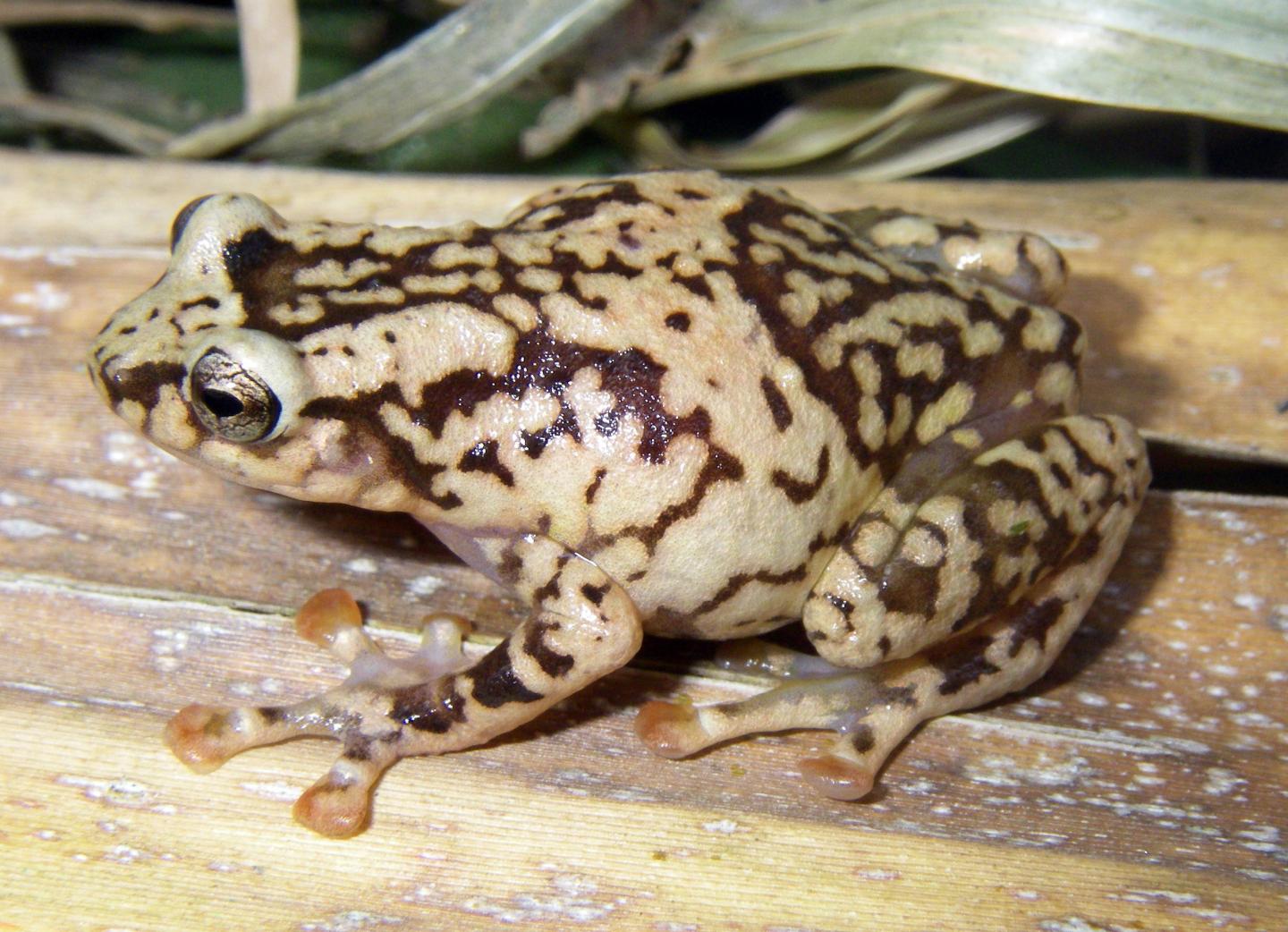
frog by Miguel Vences / TU Braunschweig

IMAGE: Chytrid fungus was proved on Platypelis pollicaris from Ranomafana. view more
Credit: Miguel Vences / TU Braunschweig

Prof. Miguel Vences from TU Braunschweig adds, “The chytrid fungus was found in all four families of the indigenous Madagascan frogs, which means it has the potential to infect diverse species. This is a shock!” The study also shows that the disease affects amphibians at medium to high altitudes, which ties in with observations from other parts of the world, where the effects of the amphibian epidemic have been felt primarily in the mountains.

“Luckily, there have not yet been any dramatic declines in amphibian populations in Madagascar,” Dirk Schmeller reports. “However, the pathogen appears to be more widespread in some places than others. Madagascar may have several strains of the pathogen, maybe even the global, hypervirulent strain. This shows how important it is to be able to isolate the pathogen and analyze it genetically, which is something we haven’t yet succeeded in doing.” At the same time, the researchers recommend continuing with the monitoring program across the entire country to observe the spread of the disease. The scientists also suggest setting up extra breeding stations for key species, in addition to the two centers already being built, to act as arks, so that enough amphibians could be bred to recolonize the habitats in a crisis. “We are also hopeful that we may be able to suppress the growth of the Bd pathogen with the help of skin bacteria,” says Miguel Vences. “It might then be possible to use these bacteria as a kind of probiotic skin ointment in the future.” A high diversity of microbial communities in the water could also reduce the potential for infection, according to earlier investigations conducted by Dirk S. Schmeller, Frank Pasmans, and their teams (published in Current Biology).

The outbreak of amphibian chytridiomycosis in Madagascar puts an additional seven per cent of the world’s amphibian species at risk, according to figures from the Amphibian Survival Alliance (ASA). “The decline in Madagascan amphibians is not just a concern for herpetologists and frog researchers,” says Dr. Franco Andreone, “It would be a great loss for the entire world.”
 
Guest post by Dr. Dirk Schmeller
Originally published:
http://www.eurekalert.org/pub_releases/2015-02/hcfe-acf022615.php

02/8/15

Frogs and Water Quality

Yesterday, in class with the Cloud Institute and Sustainable Jersey (NJ Learns), each student got to briefly share their project, so I was describing the Frogs Are Green mission and projects on the agenda for 2015.

My teacher Jaimie P. Cloud, challenged me with this question. “Much of what Frogs Are Green is about is bringing awareness to the public, but is there a change I want in the public’s behavior?”

It made me think about one specific area that we can focus on which would help frogs and amphibians as well as other wildlife and humans, and that is water quality.

We know that there are many issues, such as, pollution and oil spills, pesticides and other toxins, pharmaceuticals, and these aren’t just affecting wildlife, but us as well. It’s humans that are creating many of these problems, so it’s obvious that we must be the ones to correct it.

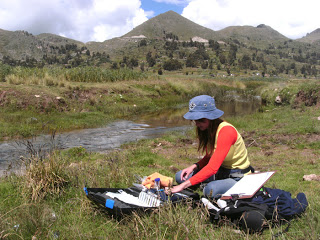
testing water quality

I did a search on Google for Frogs and Water Quality and was surprised to learn there is currently no standard for water quality as it applies to frogs and amphibians:
“The factors thought to be contributing to declines in frog populations include habitat loss, introduction of exotic species, overexploitation, disease, climate change, and decreasing water quality. With respect to water quality, agroecosystems use 80-90% of the water resources in the western United States, frequently resulting in highly eutrophic conditions. Recent investigations suggest that these eutrophic conditions (elevated pH, water temperature, and un-ionized ammonia) may be associated with frog embryo mortality or malformations. However, water quality criteria for frogs and other amphibians do not currently exist. Here, we briefly review data that support the need to develop water quality parameters for frogs in agroecosystems and other habitats.”
(from this website: PMC1519110/http://www.ncbi.nlm.nih.gov/pmc/articles/PMC1519110/)

What this tells me is that currently the water quality is tested to make sure it’s safe for humans, but there are no regulations in place for it to be safe for wildlife? Doesn’t it matter that it’s healthy for all life?

I’ll be reading much more on this issue and would like to invite you to share your thoughts or links to additional documentation you may have found.

Here’s a video I’d like to share because it shows just how important it is to educate the young with hands-on education from Marie Hartford, Science, 5th Grade Teacher and her students in Redmond, WA on the Teaching Channel about “Measuring the pH as it Relates to Water Quality.”

01/2/15

The Very Inspiring Green Blogger Award

I want to thank Lauri Fortino, children’s book author and library assistant, who writes a blog called Frog On A Blog for nominating Frogs Are Green for the Very Inspiring Blogger Award! Starting 2015 off right! Her book, The Peddler’s Bed is coming in the Fall!
The award rules:

  • Display the award on your blog
  • Link back to the person who nominated you
  • State 7 things about yourself
  • Nominate 15 bloggers, link to them, and notify them about their nominations

Seven facts you didn’t know about me:

  1. In high school, I was torn between music and art and finally decided my path would be art (I sing, but only around here).
  2. I’m allergic to chocolate. (Sad, I know!)
  3. I wish I could have more animals… dogs, fish, birds. (Maybe I should move to the country?)
  4. I read almost every night, clears the mind of other thoughts.
  5. I truly love helping people and so glad that I get to everyday.
  6. Movies are my favorite pastime, old or new, just tell me a great story.
  7. I collect children’s picture books and yes, FROG things!

My sixteen nominations for the Very Inspiring Green Blogger Award (check them out!)

Blogger awards are a great way to spread the word about blogs that you enjoy. We can all use a bit of help getting the word out. If I’ve nominated you and you’d rather not participate, that’s fine, but do consider giving a shout-out for some of the blogs you follow. Those bloggers will appreciate your support.

12/31/14

Pobblebonk Frogs in Australia

Rosemary Horton from Australia likes to keep Frogs Are Green readers up to date with her efforts to save frogs.

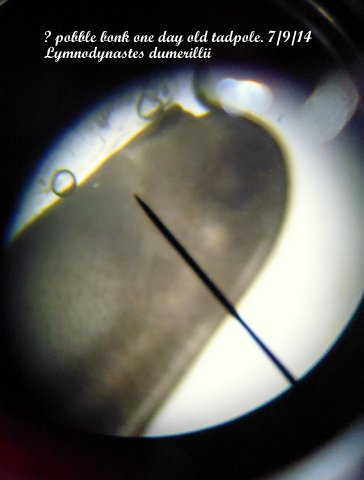
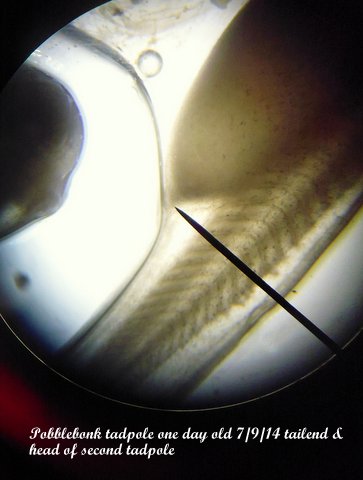
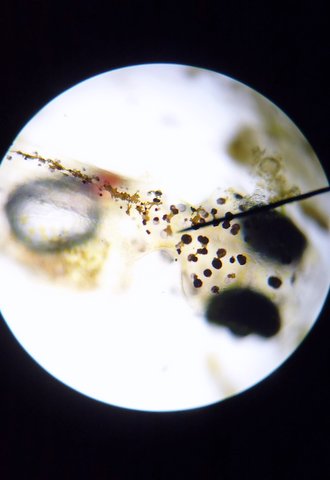
The photos below were taken with an ordinary digital camera through the lens of a school microscope, and shows the eggs and development of Pobblebonk Frogs (Limnodynastes dumerilii) to where she is ready to return them to suitable unpolluted areas.

Pobblebonk frog eggs Australia
 
Pobblebonk frog eggs Australia
 
Pobblebonk frog eggs Australia
 
Pobblebonk frog eggs Australia
 
Pobblebonk frog eggs Australia
 
Pobblebonk frogs Australia
 

About Pobblebonk Frogs from Wikipedia.org:

Limnodynastes dumerilii is a frog species from the family Myobatrachidae. The informal names for this species, and its subspecies, include Eastern or Southern Banjo Frog, and Bull frog. The frog is also called the pobblebonk after its distinctive “bonk” call, which is likened to a banjo string being plucked. It is native to eastern Australia and has been introduced to New Zealand. There are five subspecies of L. dumerilii, each with different skin coloration.