12/17/15

How To Teach Your Kids About Climate Change

 
Teaching your kids about climate change is no easy task. A lot of parents avoid talking about it with their kids because they have no idea how to bring it up. Climate change is also scary, even for adults, so great care needs to be taken when explaining things to your little ones.

By U.S. Fish and Wildlife Service Headquarters [CC BY 2.0 (http://creativecommons.org/licenses/by/2.0)], via Wikimedia Commons

By U.S. Fish and Wildlife Service Headquarters [CC BY 2.0 (http://creativecommons.org/licenses/by/2.0)], via Wikimedia Commons


It’s important that they still get a realistic overview and that you are honest with your children. However, you want to spark their interest in climate change, rather than scare them. They need to know about the problems climate change causes, but you must also find a way of explaining the solutions. They need to feel like they can make a difference.
 

Our kids and future generations need to be taught about how they can make a difference, and just how crucial their actions will be. Obviously, the depth and complexity of your conversation will depend on the age of your child. As they get older you can discuss the more complex scientific aspects of climate change, but when they are young, you just want to gently make them aware.
 

There are plenty of interesting ways you can ignite your children’s interest in climate change. Learning about the challenges the world faces doesn’t have to be too serious or boring. Here are some fantastic ways of teaching your kids about climate change.
 
Make climate change fun with educational games, apps and websites
 

There are many different tools and resources that have been created specifically for kids who are interested in the environment. Climate change is easily incorporated into lots of great games for kids.
 

There are entire websites specifically dedicated to teaching kids about climate change, and even some apps that touch on the subject. For example, NASA’s Climate Kids, Tiki The Penguin and The Young People’s Trust for the environment. There are even Apple and Android apps that help teach kids about climate change, such as Painting with Time and Offset.
 

Show them climate change videos made for kids
 
A quick search on YouTube will provide you with plenty of videos about the environment for kids. For example, this ‘global warming for kids’ video. Videos like this explain climate change in a way that kids can easily digest and process, and they are also fun to watch. Watch the videos with your kids and then let them ask questions afterwards.
 

Open their minds on family days out
 
You can subtly bring up the topic of climate change by going on educational days out. Take your kids to wildlife parks, on nature walks and to museums (such as The Natural History Museum). All these things will get them thinking about the environment and continue their education.
 

Let them explore climate by through being creative
 
Set your kids some fun tasks that are loosely related to climate change and the environment. Once they have had an introduction to climate change, get them to try and get their thoughts down on paper. They could write a poem about climate change, or try and paint their own interpretation of climate change. You could also come up with some fun climate change related games that you can play at home as a family.
 

Help them understand green living
 
Teaching your children how to live in an eco-friendly way will help enhance their knowledge of climate change. Make sure they know how to recycle and teach them to be aware of how much energy they are using. For example, switching lights off when they are not in use and not using more water than they need.
 

Let them develop a passion for nature
 
Your children may naturally become interested in climate change if they develop a passion for nature. If they fall in love with nature and enjoy spending time in the great outdoors then they are more likely to want to help protect our planet. Take your kids out walking, camping and get them involved in gardening.
 

Buy them books with underlying messages
 
If your child likes to read then buy them some climate change-related books. For young kids, the topic of climate change can be introduced gently through reading book with underlying messages. Older kids with an interest in the topic can go into much more depth. You can buy them books that teach them about how to protect the environment and that explain the science behind climate change.
 

The following is a guest post from Edward Woodward. A writer and a blogger at Kedel blog.

12/13/15

Reptile Kingdom Resides in Painting Workshop

Dec.6, 2015
Text by LAN Lianchao
Video by LAN Lianchao & CHANG Zhuojin & SHI Xinyue & LIU Yuting

Hundreds of transparent boxes are piled up against the wall, with simulated wild environments. The residents of those cubical rooms have watched the day and night of the painting workshop, ARTTRA, for seven years.

The vivarium belongs to a painter, Herman Chan, 41, who has over 100 reptiles from about 50 species.

“Maybe you can not find a second painting workshop with so many reptiles in Hong Kong,” he says.

Chan’s pets attract people who learn painting in a way of improving their ability of observation. Reptile knowledge is a bonus for curious students.

Chan says he collects and breeds various species of reptiles on purpose. “I enjoy taking care of them technically,” he says.

The first reptile owned by Chan was a salamander when he was in the primary school. Since then he has never stopped.

Chan used to raise his reptiles at home, afraid of customers’ resistance against them. He says he hopes to stay with them more, not only the time after work.

Not until he took a chameleon to the studio did he find the charisma of his pets. Children are really into it and inspired to watch the detailed of the animal, Chan says.

Meanwhile Chan tells them chameleons change color due to the temperature, humidity or light, not the background colors thought by many people.

“The studio is a perfect combination of my hobby and job,” Chan adds. “It is an incubator for my reptiles and my painting.”

Chan Tsz Yin Andrea, 5 yrs old, Hong Kong, Arttra.

Chan Tsz Yin Andrea, 5 yrs old, Hong Kong, Arttra.

With the Frogs Are Green annual children’s art contest deadline approaching, you can see how engaged the young students are by learning about amphibians and reptiles, seeing them up close, and then expressing themselves through art. I’m thrilled that Herman’s students entered our annual contest!

This blog was originally posted on https://lanlianchao.wordpress.com Frogs Are Green has permission to repost it.

12/8/15

Foliage For Indoor Frogs

Frogs are one of the more common classroom pets because they are quite easy to care for and they look very cool. Growing frogs is a great way for science teachers to teach kids about metamorphosis because they can use the frog as example for this process. Frogs at first are tadpoles and then they turn into an adult frog. But there are a few things that you should know if you are thinking about raising a frog in a classroom or in other indoor spaces. One of the most important things being what type of foliage to use for the frogs as that can determine how the frogs feel in their classroom terrarium because plants provide the frogs with cover as well as help with the oxygen production in the vivarium. This foliage will be different based on what type of frog you have – an aquatic, semi-aquatic, terrestrial or arboreal (climbing or tree) frog.

frog_pic

Foliage for aquatic frogs
Because aquatic frogs tend to spend most of their life underwater these frogs will require to live in vivarium where there is a lot of water which means that you will have to have aquatic plants too, because regular land plants won’t be able to survive in the water or in a place where it is very moist and wet. Common plants that grow and feel well in aquatic environments are Anubias species plants, which are very durable aquatic plants; Pothos Plants and Philodendron that are long vine type plants that will nicely cover your aquatic terrariums wall; Cryptocoryne wendtii, which are tall plants with heavy foliage; as well as Anacharis plants that the frogs can use to hide among and other similar plants. But for classroom purposes you can also make a biotope aquatic tank meaning that you place all of the same plants that can be found in the natural habitat of the frog species that you have in your terrarium.
 

Foliage for semi-aquatic frogs
Semi-aquatic frogs are called that because they spend half of their time in the water and half on land and they need appropriate tanks with 50% of the tank being water but and the rest being land. This also means that in a vivarium for these types of frogs you can combine aquatic plants and also non-aquatic plants. Just keep in mind that these non-aquatic plants too should favor a moist environment and soil so don’t place plants that prefer dry conditions in a semi-aquatic tank. For the water portion of the terrarium you can again use the same aquatic plants that I mentioned previously, but for the land portion of the tank you can use plants like Bromeliads that will adapt to basically any environment, as well as Ferns that are high humidity plants and other plants that can stand humidity and their roots being constantly wet.
 

Foliage for arboreal (tree) frogs
Then there are so called arboreal or tree frogs that need a lot of climbing space meaning that their vivarium too needs to have taller plants with climbing potential. Great plants for frogs of this type are Philodendrons that grow really fast and in basically any conditions; Wandering Jews that also are quick growing plants; plants called “Golden Pothos” that is adaptable and an easy growing plant; Aglaonema genus plants that can reach up to 3 feet, as well as Marcgravia or Shingle Plant that has fat leaves and tends to climb on other surfaces; and a plant by the name of “Silver Skies” that also grows fast and has big leaves.
 

Foliage for terrestrial frogs
Lastly, there are quite a lot of frogs that are categorized as terrestrial or land frogs. For these types of frogs you can create a vivarium that is quite similar to one that I described for arboreal plants. However, in the terrestrial frog case they don’t need the height of the plants but rather they need bigger and longer spaces that are heavily clad with foliage because these frogs need places to hide and they are not able to climb the plants like tree frogs can. For terrestrial frog tanks you can use plants like Peperomia and Pilea plants, both are plants with many different species that are all good for terrariums, as well as Orchids because they don’t like wet places and other house plants or land plants.
 
One thing to keep in mind with terrariums and plants though is the light that they get because for any plant to grow they need light for photosynthesis to happen. The more light plants get the faster they grow, so make sure that in the classroom the frogs are placed in a spot where it gets natural lighting. An alternative of course, which in many cases might be even better than natural light, is to install t5 grow lights or any other similar artificial lights above your terrarium, because with these artificial lights the plants as well as the frogs will get the light and heat they need and you will be able to control the conditions in the terrarium so that they are just perfect for the species of frogs you have.
 

bio_photo

*** Guest post: My name is Ben Thorton and I am the owner and editor of T5fixtures.com. My passion is all things related to plants and plant growing and I consider myself an expert in this field, which is why I love to share my passion with others to help them be successful in gardening and plant growing too.

12/4/15

Environmentalism: It’s up to YOU to teach the young

It’s December and there are just 11 days left for children to enter the 2015 kids art contest, and all ages to enter the photo contest. As I watch artworks and photos trickle in, I’m wondering (as I did in 2013) why aren’t more people participating? (read >> The Young Environmental Artist)

I see a pattern here. The climate talks are on in Paris, but most are just talkers and not doers. It’s not enough to “like” and share pictures and articles on social media, and not actually do something to show you care.

My own Jersey City made me proud last year with close to 200 students from 17 schools submitting artworks. In addition, we received artworks from 17 states in the US and 32 countries around the world. The total last year was close to 1000 pieces of creative expression. It was marvelous! The winning artworks were celebrated online and in 3 well received exhibitions including an exhibition in Jersey City’s City Hall.

Jersey City is a culturally active area with a large artist community, and yet these same artists, many who have children, aren’t participating either. So, I’m back to wondering why it’s easier for me to reach parents and teachers in other countries and not those in my own area?

I’m asking you now… educators and parents to explain to the young why they should care about wildlife and the environment and I’ll continue to do my part to help amphibians and the environment too.

Please make me proud by entering today!


Susan Newman,
Founder, Frogs Are Green, Inc.
A NJ nonprofit organization – “Healthy frogs mean a healthy planet for all.”

Below is one of my favorite entries from 2014.

1st Place Winner, Kardelen Koc, Turkey, Frogs Are Green Kids Art Contest 2014, age 3-6 group

1st Place Winner 2014, Kardelen Koc, Turkey, Frogs Are Green Kids Art Contest 2014, age 3-6 group

10/20/15

Frog color patterns and the lack of color on the ventral surface

Frogs are a component of an exclusive cluster of the animal realm that have a part in the subtle equilibrium of both the ecosystem and the food chain. Frogs can be seen more or less any place apart from Antarctica. The majority of frogs are found in tropical areas and more frogs are found in the hotter countries. There are approximately 4,740 species of frogs on the planet. They are in fact remarkable creatures that come in a huge range of sizes as well as colors.

Frogs generally eat insects such as flies, as well as, worms and small fish. In some cultures, frogs are believed to bring good luck. Noticeably, some frogs, such as the poison dart frog, have an adequate amount of toxin in their miniscule bodies to take the life of a human being. Some species of frogs are capable of changing their skin color, and a few of them have a similar skin color as their environment.

By liz west (leopard frog2) [CC BY 2.0 (http://creativecommons.org/licenses/by/2.0)], via Wikimedia Commons

By liz west (leopard frog2) [CC BY 2.0 (http://creativecommons.org/licenses/by/2.0)], via Wikimedia Commons

Without a doubt, frogs have several natural predators. Generally frogs are responsive to predators, which is why frogs put down a lot of eggs at a time. A few of the main predators of frogs are comprised of reptiles, like snakes and lizards. Some fish will eat frogs, and birds will also eat frogs. Frogs are always in danger of predators and unfortunately, humans also eat frogs. Luckily, frogs have developed many techniques for defending themselves from these predators.

The color patterns of frogs and their lack of color on the ventral surface, allow frogs to escape from predators. Usually, the underside of the frog is a lighter color than the top side for the reason that if the frog is hanging on top of the water and a predator is searching for a frog, the suns glare makes the frog difficult to spot. There are shady marks on the bottom and as a result it doesn’t expose the silhouette of the frog. Some of the frog’s upper side is darker since when swimming in the underneath of a dark pond, so it coordinates with the bottom.

By fa:User:Juybari (fa:File:Frog in Water.jpg) [GFDL (http://www.gnu.org/copyleft/fdl.html) or CC-BY-SA-3.0 (http://creativecommons.org/licenses/by-sa/3.0/)], via Wikimedia Commons

By fa:User:Juybari (fa:File:Frog in Water.jpg) [GFDL (http://www.gnu.org/copyleft/fdl.html) or CC-BY-SA-3.0 (http://creativecommons.org/licenses/by-sa/3.0/)], via Wikimedia Commons

Frogs have a huge range of skin colors and patterns, which indeed help them from their natural predators. Colors can aid as a warning to predators that the frog may be toxic. Some frogs have the ability to change the color of their skin to adjust their heat soaking up rate, which assist them in managing their temperature. Just like other creatures, a frog’s skin and its color can be a sign of poison. Eating a blue frog can be deadly. So, the blue colored frogs offer a sign that they are not edible.

By Michael Gäbler (own work (eigenes Werk)) [CC BY 3.0 (http://creativecommons.org/licenses/by/3.0)], via Wikimedia Commons

By Michael Gäbler (own work (eigenes Werk)) [CC BY 3.0 (http://creativecommons.org/licenses/by/3.0)], via Wikimedia Commons

Some studies have shown that the techniques for getting the better of a predator rely on the species of frog, but several of these resistances contain the utilization of color. It is found that some of the frogs have developed patterns on their backs that bamboozle or confuse aerial predators. The patterns cover up the shape of the frog; as a result, the predator doesn’t identify it as something safe to eat.

The largest parts of frogs are not dangerous, but there are some frogs that take advantage of poison as a self-protection tactic. Research reveals that some frogs have deadly poisons that could make a human harshly sick, or even kill someone. The toxic frogs such as the poison dart frog generally have brightly colored skin that stands as a caution. The toxic frogs have in fact very few predators. Frogs such as the barred leaf frog have light patterns on their legs and body. So, when the frog runs, these patterns will make the predator puzzled.

The animal kingdom makes use of a lot of tactics in order to save themselves from predators. Frogs are amazing and they use a lot of techniques to fool predators. Basically the upper surfaces of frogs are dark and go with their environment so that they are hidden from predators viewing them from above. The ventral surfaces of most of the frogs are normally a light color so that it will be disguised against the lighter sky while observed from underneath.

On land, a frog’s enemies will attack them from above and therefore, the color on its upper side serves as concealment. In water, the frog is susceptible to assault from below. For the most part, frog’s ventral surface is seldom uncovered to the sight of predators, so these surfaces don’t require camouflage. Frogs have a variety of patterns and colors that protects them from natural predators and harsh environments.

——–

Guest blog by Ligia Blake, who is a freelance blog writer and works for essayscouncil.com, a custom essay writing service with a passion of helping out students.

09/27/15

Washington Park LIVE 2015 and Frogs Are Green

Frogs Are Green began setting up the organization’s tent at 9 am! This year, thanks to the Washington Park Association, we had an incredible spot in the front of the “Washington Park LIVE” festival with a large tent, grid bars tied to the back, and two tables! One table for displaying educational information such as our books: the teaching resource curriculum, “Frogs, Amphibians and Their Threatened Environment,” and previewing our next book, “Rainforest Frogs,” which features Haiku poetry by Caley Vickerman, illustrations by Mark Lerer, a foreword by Franco Andreone, and designed by founder, Susan Newman. We also had on display materials about the contests being open right now, the 6th Annual Kids Art Contest & the 7th Annual Photography Contest. On the back grid we hung our posters to draw the eyes… and it worked! It was so interesting hearing which posters visitors liked the most… I’ll be ordering a bunch more of each of those!

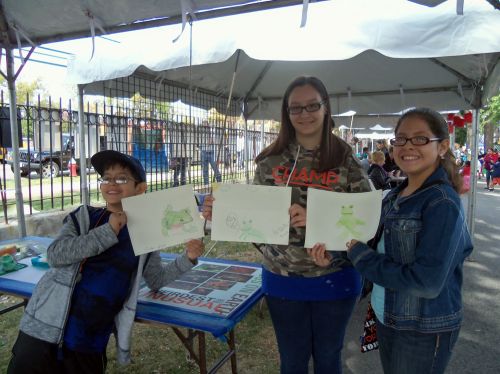
The second table we covered with some mounted posters which were tapped down, as an inspirational guide of frog image reference for visitors. Those that wanted to draw frogs, they were right there on the table! On hand were colored pencils, crayons, markers, lots of paper and even frog stickers.

We greeted over 130 people of all ages during the day, and everyone enjoyed creating frogart. You’ll see from the gallery of images below both children and adults got into it. This was our most successful event yet as we sold out of our t-shirts and a bunch of posters.

We also enjoyed dancing to the music being played on the sound stage right near us, and there were plenty of food truck vendors for us to taste assorted delights, such as lobster rolls and chocolate treats.

I look forward to seeing the photos by others showing what else was happening around us.