04/7/13

Kihansi Spray Toads: Once Extinct in the Wild, Now Reintroduced to their Native Habitat

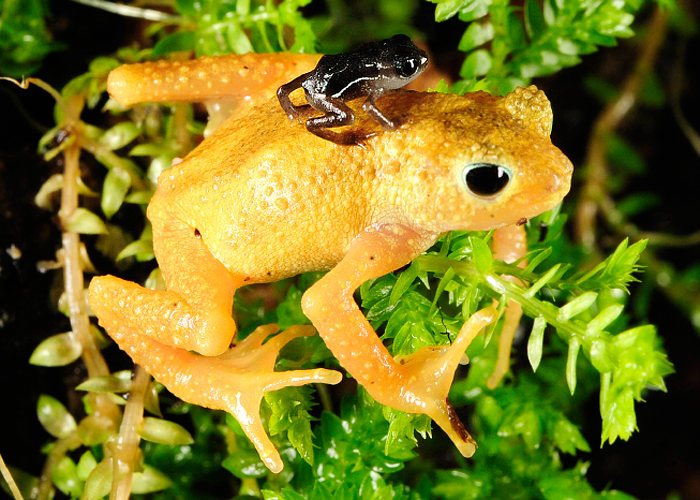
Female Kihansi Spray Toad with her young toadlet. Courtesy of the Wildlife Conservation Society. Photo: Julie Larsen Maher

Female Kihansi Spray Toad with her young toadlet. Courtesy of the Wildlife Conservation Society. Photo: Julie Larsen Maher

Recently more than 2,000 Kihansi spray toads (Nectophrynoides asperginis), an amphibian species that was declared extinct in the wild in 2009, made the long journey from Toledo, Ohio, and Bronx, New York, to Africa. They were returning to their native habitat in the Kihansi Gorge in Tanzania.

These tiny toads are unique in that they live in a micro-habitat—it was created by the spray of nearby waterfalls in the Kihansi Gorge and covers only five acres. This is the smallest range of any known vertebrate species.

In 1990, a hydroelectric dam was constructed that reduced the spray of the falls by 90 percent and so lessened the mist zone that the toads needed for survival. The toad population was also devastated by the chytrid fungus, which has devastated amphibian populations worldwide.

As the toad populations were declining, the Wildlife Conservation Society’s (WCS) Bronx Zoo, and later the Toledo Zoo, in agreement with the Tanzanian government (and with the help of numerous organizations—see below), removed 500 toads from the gorge and brought them to the US. Special microhabitats were created for the toads and both zoos were able to breed them successfully.

Now over 2,400 toads have been successfully released in the wild. Before being released, scientists from the University of Dar es Salaam and Sokoine University of Agriculture certified the area as being free from chytrid fungus.

This is the first time that an amphibian that was extinct in the wild has been returned to its native habitat.

Organizations involved in reintroducing the kihansi toad to the wild include the Wildlife Conservation Society’s Bronx Zoo, the Toledo Zoo, Tanzanian government, World Bank, University of Dar Es Salaam, International Union for Conservation of Nature (IUCN), Wildlife Division and Tanzania Wildlife Research Institute, Sokoine University of Agriculture, Tanzania Electric Supply Company, and local Tanzanian villagers all took part.

Sources:

Scientific American
All Africa.com 
Hudson Valley Press

10/18/12

Axoloti: Treasured by Ancient Aztecs and Modern Scientists

We recently read an alarming statistic: it’s possible that only one hundred axolotl salamanders (Ambystoma mexicanum) exist in the wild.  Why should anyone care that a strange Mexican salamander may soon be extinct in its native habitat?

It turns out that this salamander is a remarkable creature. It intrigued the ancient Aztecs because of its strange looks and regenerative powers and was believed to be a manifestation of the god Xolotl, who like Charon in Greek mythology, was the ferryman of the dead to the underworld. To the Aztecs, the salamander’s regenerative  power was like that of the lake system that sustained them.

Most salamanders are able to regenerate body structures to some extent. But the axolotl is unique in that it can regenerate not only limbs, but also its jaws, spinal cord, and more. After these body parts regenerate, there is no evidence of scarring. Axolotls can even receive transplanted organs from other individuals and accept them without rejection.  They are one thousand times more resistant to cancer than mammals. This, of course, has made them of great interest to scientists who study them in captivity.

The axolotl is also one of the few animals that exhibit neoteny, that is, it retains its juvenile characteristics, such as the external gills, which gives the creature its cute looks.

By th1098 (Own work) [CC BY-SA 3.0 (http://creativecommons.org/licenses/by-sa/3.0)], via Wikimedia Commons

By th1098 (Own work) [CC BY-SA 3.0 (http://creativecommons.org/licenses/by-sa/3.0)], via Wikimedia Commons

But this animal, despite its “smile,”  has a lot to be unhappy about. Its only habitat is the canal system of Xochimilco in Mexico, which is what is left from what was an extensive lake and canals that connected most of the Aztec settlements of the Valley of Mexico. These canals, along with artificial islands called chinampas, attract tourists and other city residents who ride on colorful gondola-like boats around the hundred or so miles of canals. This canal and chinampa system, as a vestige of the area’s pre-Hispanic past, has made Xochimilco a World Heritage Site.

Unfortunately the canals are polluted with both garbage and fecal matter, as well as industrial fertilizers. Other problems include the damage by introduced plant and animal species. Carp and tilapia fish, for example, introduced in the 1960s, eat the eggs of the axototl.

The axolotl faces long odds for survival. It seems that only a complete regeneration and clean up of the historic canals will save this animal that is often considered a metaphor for the soul of Mexico.

Information for this post came primarily from an article and blog post from the LA Times and a Scientific American blog post. Note: the axototl is also know as the ajolote.


05/11/12

Saving Frogs (and a Village) in Ireland

We recently received an e-mail from Laurence Stafford, who lives in a small village called Parteen in County Clare, Ireland. A highway is being proposed that will cut through his village, destroying the habitat of the Irish Common Frog (Rana temporaria).

Photo courtesy www.doeni.gov.uk

Laurence’s e-mail highlights the problem of habitat destruction. What does it matter that frogs are losing their habitat in one small area of Ireland? Unfortunately this type of habitat loss is occurring across the globe: it is one of the reasons for the rapid worldwide amphibian decline. Of course, having a highway cut through a village will have enormous human costs as well.

The story is as follows: there is a joint venture between Limerick County Council and Clare County Council underway to build a highway costing over 352 million euros that will connect Galway to the University of Limerick. The highway will cut through Parteen village.

The Environmental Group of Parteen has warned the emerging preferred route crosses rural farmland, which is home to a protected species, Rana Temporaria. Although this species is fairly plentiful in Ireland, it is protected under an EU directive because of its declining numbers in Europe. The directive aims to protect some 220 habitats and lists approximately 1,000 species, including the frog.

This road will also divide a peaceful and tranquil village in two; the proposed volume of traffic is estimated at 20,000 to 30,000 cars, which calculates at 210,000 a month and 2,520,000 a year passing through a small community.

As reported in the Clare Champion, the group’s concerns are shared by Councillor Pascal Fitzgerald, who is disappointed with the planning of the new road, which he claims will divide settled communities and destroy their living environment: “Even people who have no connections with the area are asking why areas that have been ideal for living in are now to virtually have their heart cut out.”

We hope that the local county councils will rethink this route, both to preserve the frogs’ habitat – so important in this time of declining amphibian populations worldwide – but also to preserve the integrity of the village of Parteen.

Here is more information. Ecoparteen’s Twitter feed is here. Please lend your support!

04/4/12

How Does a Toad Cross the Road? With a lot of Help from their Friends

As the days are getting longer and the sun is getting warmer in the Northern Hemisphere, a young male toad’s thoughts turn to love – it’s mating time for amphibians. Unfortunately this springtime ritual is often fraught with danger for frogs and toads. As we were looking for stories for this week’s post, we noticed a lot of stories about how people in Britain and the U.S. are helping toads make this important but dangerous journey. Here are a few:

Great Britain

Blades of glass rustle as hundreds — if not thousands — of toads spring forth from hibernation, each one a bloated, wart-ridden, writhing mass of arms of legs. Then, wide-eyed and kamikaze-like, they fall from the high kerb [curb] before making a desperate dash across the road, determined to reach their hereditary breeding ground. (As reported by  in the Henley Standard, Henley-on-Thames, England)

Unfortunately the toads in Henley must contend with a human-created challenge — rush-hour. Local toad patrols, however, are helping the toads cross the road. This year they’ve saved 7,500 toads from road death.  The toad patrols can’t stop traffic, but motorists slow down when they see their toad crossing signs and their high-visibility jackets.

Henley Wildlife Group Toad Patrol, courtesy of the Henley Standard, Henley-on-Thames, England

Volunteers spent every night of the past month helping toads by carrying them in buckets. The Toad Patrol happens every year and saves about 80 per cent of the migrating population of toads.

The BBC reports that in Northhampshire, England, hundreds of toads make a yearly one-mile journey from a woodland across a number of roads to an area that is now a housing development in the village of St. Crispins, to the south of Northampton.

Many toads are squashed by cars and dozens more fall into drains as they try to get back to where they were born. But those that do make it alive will find that the pond has been replaced by buildings. Donna Robins, a toad patroller, was quoted in the article as saying: “My house is on the woodland where they used to live, I feel responsible. I see them getting killed every night on the road.”

In Edinburgh, Scotland, the Historic Scotland Rangers are helping out with the toad annual ‘Watch Out, Toads About,‘ which helps toads migrate. Early every morning Rangers carry out patrols to check the nooks, crannies, and drains in Holyrood Park to make sure each toad gets to its destination safely.

In winter the toads live around Arthur’s Seat [the beautiful small mountain right outside the city] and Dunsapie Loch. In order to get to where they spawn, they must cross a public road with high curbs. When the toads are tired and hungry they can become disoriented and may be unable to make that last leap to safety. Volunteers are needed to help the roads cross the road safely.

United States

As reported in the Roxborough (PA) Patch.com, frogs and toads are on the move and in an annual tradition,the Schuylkill Center for Environmental Education has helped them along.

photo courtesy The Schuylkill Environmental Center

The environmental group coordinates volunteer shifts to aid the toads crossing roads. There’s lots of information about volunteering on their site. After the toads breed, the toadlets, about the size of a fingernail, make their move from May 15 to June 30 and hop back to the woods, so volunteers can pitch in later, too.

Recently, according to the Provincetown (MA) Journal, the Cape Cod National Seashore issue an announcement that beginning this spring and continuing through October, certain local roads will  be closed at times, particularly on rainy nights, to protect the spadefoot toad, which is listed by the state as a threatened species.

These unusual toads, one of 12 species of amphibians found within the Seashore, use shallow, temporary ponds for breeding, and the surrounding uplands to feed. They migrate to and from these ponds on rainy nights, especially when the water table is high and temperatures are above 48 degrees.

The toads must cross paved roads, and during such crossings many of these well-camouflaged creatures are unfortunately killed by moving vehicles. Thus there is a need for carefully timed, strategic, temporary detours.

The Province Lands area of Cape Cod is one of the last strongholds for the eastern spadefoot toad in Massachusetts, and the public’s cooperation — and forbearance — is urged in the effort to ensure their survival.

As reported in the article [and mentioned as a difficult issue in some of the other articles cite above], sometimes the public isn’t very enthusiastic about the measures to help amphibians:

A related challenge to protecting these elusive creatures is raising the public’s consciousness about their importance environmentally. By their very nature, spadefoot toads do not attract the throngs of admirers that, say, whales do. Because of their size, habits and habitat, the toads are hard to find and quantify, and are challenging to study. Further, by most standards, they are not very glamorous — except perhaps to herpetologists.

While their tiny, almost invisible close “cousins” the spring peepers can claim status for their joyful, lilting songs that herald the arrival of spring on the Cape, the pained dyspeptic croaking of a spadefoot induces no similar elation. However, in the larger environmental scheme of things they are important marvels of adaptation….

The public can listen in on recordings of frog and toad calls, as well as discussions on amphibian ecology, via links to podcasts and videos on the Seashore’s website. At Frog are Green, we’d like to wish these toads “safe travels” and applaud all  the Toad Patrols in the US and the UK who are helping them along on their journeys.

02/5/12

Good news for endangered California frogs

We were happy to learn that a few days ago the California Fish and Game Commission voted unanimously to designate two species of native yellow legged frogs inhabiting high-elevation lakes in the Sierra Nevada and Southern California mountain ranges as threatened and endangered species under the state’s Endangered Species Act. The commission acted after the Center for Biological Diversity filed a petition outlining the decline.

photo courtesy National Park Service. Department of the Interior

According to the Center, the population of Sierra Yellow legged frogs has decreased by 75% in recent decades. Reading about these frogs, we were struck by how they are a symbol of the challenges that frogs face worldwide. But they aren’t facing one challenge—they seem to be facing almost all of them:

Introduction of nonnative species: Stocking of nonnative trout in high-elevation Sierra lakes has been the main cause of the species’ decline. The trout eat tadpoles and juvenile frogs and alter the food web of the aquatic ecosystems on which the native frogs depend. The Department is recommending no trout stocking in the state without a fish management plan, and no further stocking of trout in areas that would conflict with protecting yellow-legged frogs.

Pesticides: Recent research has linked pesticides that drift from agricultural areas in the Central Valley to declines of native amphibians in the Sierra Nevada. Pesticides and other pollutants can directly kill frogs and also act as environmental stressors that render amphibians more susceptible to diseases, including a chytrid fungus that has recently ravaged many yellow-legged frog populations.

Loss and degradation of habitat: Grazing, logging, water diversions, off-road vehicles and recreational activity are allowed in frog habitat.

Climate change: Climate change has brought warmer temperatures, decreases in runoff, shifts in winter precipitation in the Sierra from snow to rain, and habitat changes that are rendering frog populations more vulnerable to drought-related extinction events.

A recent settlement agreement with the Center for Biological Diversity, which will also speed protection decisions for 756 other species, requires the U.S. Fish and Wildlife Service in 2013 to make a decision about whether to add the Sierra frog to the federal endangered list.

See the Center for Biological Diversity for more information about these frogs and about the other endangered species they are working to protect.

12/1/11

The Painted Hula: A Frog Hits Prime Time

The amphibian crisis is an environmental issue that hasn’t really hit the mainstream yet. Most people we talk to are surprised to hear that an entire class of animals is in deep trouble, with one-third of amphibian species facing extinction. So we were very happy when Rachel Maddow did a piece two weeks ago on her show about the newly discovered Hula painted frog (Discoglossus nigriventer) (see video below).

painted hula frog from Y Net News

Painted Hula Frog from Y Net News Website

Here’s the story of the hula painted frog, from Conservation International’s website:

The frog was discovered in Israel’s Lake Hula, one of the world’s oldest documented lakes, which provided fertile hunting and fishing grounds for humans for tens of thousands of years.

In the early 1950s, the lake and surrounding marshes were drained as a way of tackling malaria. But the costs for doing this were high. Among other environmental problems, draining the lake led to the near extinction of an entire ecosystem and the unique endemic fauna of the lake, including the Hula painted frog. Ironically, species such as the painted frog feed on mosquitoes that carry malaria.

Concern over the draining of Hula grew among the people of Israel, leading to the formation of the Society for the Protection of Nature in Israel and a movement to reflood the Hula Valley. It took 40 years for the protesters’ voices to be heard, but in the mid 1990s, parts of the valley were reflooded.

While much of the ecosystem was restored, not all species re-appeared and it was believed to be too late for the Hula painted frog; the species was declared extinct in 1996 by the International Union for the Conservation of Nature (IUCN). The frog became a poignant symbol for extinction in Israel.

Only three adult Hula painted frogs had ever been found. Two of these were collected into captivity in the 1940s, but the larger one ate the smaller one, leaving just one specimen to remember the species by.

The enigmatic frog was selected as one of the “top ten” species during the Search for Lost Frogs last year, highlighting the global importance of this species. It was lost but not forgotten.

Recently, however, Nature and Parks Authority warden Yoram Malka was conducting his routine patrol of the Hula Nature Reserve when something jumped from under him. He lunged after it and caught it: he was holding in his hand the first Hula painted frog seen since the 1950s.

To quote the CI site:

This rediscovery is the icing on the cake of what is a major victory for conservation in Israel: the restoration of a rare and valuable ecosystem. Because Israel has given the Hula Valley a second chance to thrive, the Hula frog has gone from being a symbol of extinction to a symbol of resilience.

Mazel tov, Dr. Moore! And thanks, Rachel, for reporting the story.

Visit msnbc.com for breaking news, world news, and news about the economy