07/14/13

Herps Alive! A Reptile Rescue Herpetologist Writes About Frogs

Guest Post by Keith Gisser

I know what you are thinking.

Why is a reptile rescue guy writing about frogs? They aren’t reptiles. And captive frogs don’t need to be rescued. Gators, boas, pythons, maybe even big monitor lizards and iguanas, sure. But frogs?

Herps Alive! The Interactive Reptile and Amphibian Experience, is a traveling educational herpetology program and display. We have presented in 36 states (primarily at college campuses, but also at libraries, festivals elementary and high schools). Now in my fifties, I did my first paid program at age 17,  and now my daughter a degreed Interpretative Naturalist, and my son, a marketing whiz, often travel and help me. We offer display programs and interactive lectures as well as classroom sessions, and have presented an estimated 3,000 programs since we started (we have worked some “real” jobs here and there).

As your reputation builds, you start getting calls to adopt animals. Usually they are pets that people can’t keep. Sometimes they are police seizures or animals from other unfortunate situations.  We have always accepted these animals in an effort to keep a good relationship with the museums, nature centers and law enforcement officials who contact us.

But in the last year or so, the rescue mission has taken on a life of its own.  We have been asked to take in dozens of animals. And for the first time, we began rehoming a few. As a result we are spinning off our rescue mission and working on moving it to a separate location, as we turn it into a charitable foundation.

But what about the frogs?

I have been fascinated with frogs my entire life. My career as a herpetologist probably began at age nine when I caught a toad. I brought him home in a rinsed out pickle jar. (That was 45 years ago when such behavior was acceptable. At the time they were also in the genus Bufo, not Anaxyrus) I have bred several species of frog in captivity and always include a discussion of metamorphosis in my educational programs.
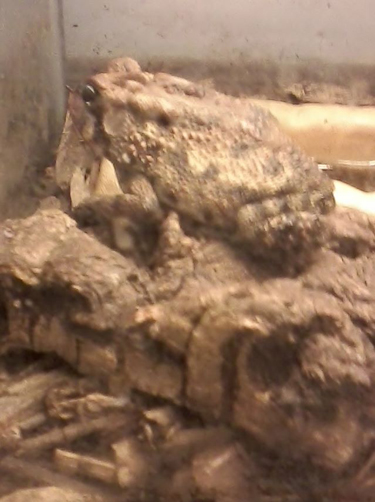
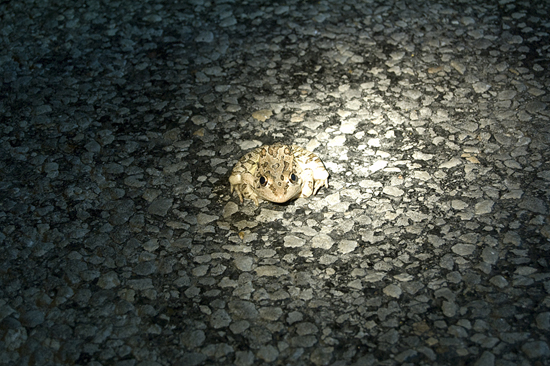
Southern Toad

Right now we have three frogs among our 150 animals.  Our Southern Toad (Anaxyrusterrestris) was living in a Carolina classroom after a student had brought him. He had been in captivity for too long to be released, so when we came in to do a program, the teacher asked if we could take him. Known just as The Toad, he eats crickets and small worms, as well as waxworms.

Beatrice is an African Clawed Frog (Xenopuslaevis) who was raised from a small size by my son’s ex-girlfriend. When she moved into a new home, she asked us to take her on. Beatrice was raised in a 10 gallon aquarium. When we tried to move her to a larger one, she went off feed and seemed generally unhappy. So back into the ten she went even though it really is too small for her. She loves her goldfish and nightcrawlers and eats anywhere from 10-30 a week. Unfortunately, her relatives have been taking a bad rap lately as they have been identified as the culprits that carried of the dreaded chytrid fungus.  It’s not really their fault. In everywhere except their African home, they were used as lab animals. They were used as part of a pregnancy test. The problem is not with them carrying the fungus, but rather with the irresponsible people who have released them outside their normal environment.
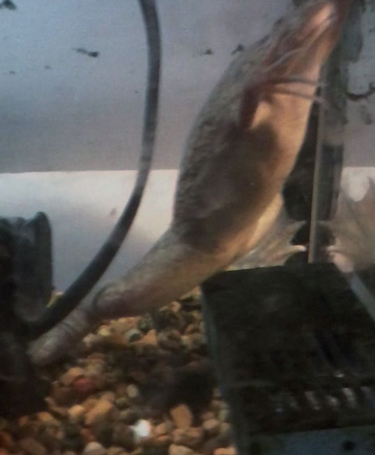
African Clawed Frog

Finally, there is Poncherello Pegone Pixiefrog, our African Bullfrog (Pyxicephalusadsperus). “Ponch” is named for the  mayor on the cartoon My Gym Partner’s a Monkey., who is also a Pixie, or African Bullfrog. We adopted him from a breeder because he appears to be blind in one eye and the breeder did not want him. Ponch eats thawed mice off tongs, usually one or two a week. He is also a regular in our programs, having traveled to 14 states since we got him two years ago. While our other frogs are kept in our entrance hallway (Our facility is not air conditioned), Ponch loves the heat and his aquarium is kept in our snake and lizard room, where the high ambient temperature helps him with digestion.

We hope to see you some time in the future…

About Keith Gisser:

Keith caught a toad (Anaxyrus ssp) when he was nine and his herpetology career began. He has presented Herps Alive! an award-winning, nationally recognized interactive reptile and amphibian program based in Ohio, at over 170 college campuses and hundreds of other venues in 39 states.

Gisser, who has been a herpetology educator for over thirty years and currently maintains about 140 reptiles, amphibians and crocodilians, nearly all of which are adoptions or rescues, about half of which are used in his programs. The rescue and adoption mission has taken more and more of his time and efforts in recent years and will soon be “spun off” as the Herps Alive! Foundation, which is in the process of seeking non-profit status and accreditation as a rescue.
07/4/13

Frogs Crossing the Road in the Rain

Rio Grande Leopard Frog by Sara Viernum

Rio Grande Leopard Frog by Sara Viernum

A frog fan, Brian, emailed about the frogs in his area crossing the road when it rains, and I asked a few experts to advise him. We all agreed to share this content so you can know what to do in your own area.

Brian asks:
To reiterate our conversation, there is an ecosystem in and around the Salt Pond community in Bethany Beach DE, which subsequently is intertwined by a few roads. There is one particular stretch of about two blocks where, like clockwork, when it rains the frogs cover the street. It seems to be two species doing this; the bull frogs and little peepers. I did a rough estimation of about 125 of these frogs are being killed by car traffic every time it rains. That’s roughly 4000 per summer season. What is it about the rain that draws these frogs to the pavement?  And what practical solution can be done to lessen the slaughter?

Best regard, Brian H.

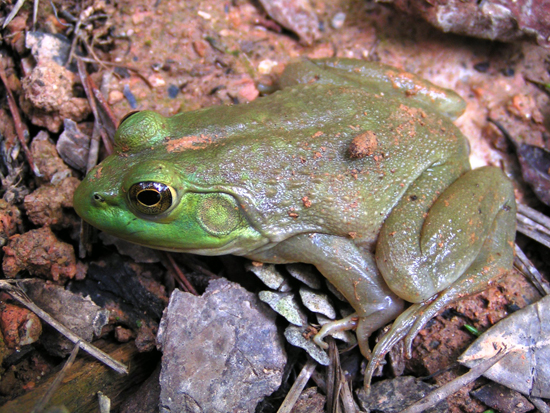
Bullfrog by Sara Viernum

Bullfrog by Sara Viernum

Two responses from the experts:

Hi Susan and Brian,
Happy for others to chirp in as well, but the frogs are not so much attracted to the pavement, but the rains signaling the fact that its time to breed!  So when this happens the frogs migrate from where they live their everyday lives to a suitable breeding site, which hopefully still exists.  I’ve seen cases where the traditional ponds have been turned into carparks or shopping malls and all the frogs turn up and say “WTF?” And inevitably die.  There is another explanation and that depends upon the size of the frogs – if they are adults then the above explanation is probably true, however if they are metamorps or juveniles then its quite likely this is a mass migration AWAY from the breeding site of newly developed froglets to find a good place to live and the only way they can avoid drying out on the hostile pavements is to travel when it rains.

OK – what can be done to save them?

People try many things, during rainy days you can get volunteers to help the frogs across the roads, you can put signs up to warn motorists and tell them to be careful, you can close the roads – all these have differing successes depending on manpower, but the best solution is to advocate for some frogs tunnels and drift fences to be installed.  Essentially you erect a barrier, which for these species would need to be carefully constructed as peepers can climb very well and bullfrogs can jump very well, and these barriers prevent the frogs from crossing the road and direct them to an underpass where they can cross the road safely (obviously the same needs to happen on the other side so that they don’t get squashed coming back).  Having said all this, both the species mentioned are fairly common species and are not under threat (although it would be good to get their ID professionally confirmed) and are not in decline – at the moment, so it would be difficult to motivate city councils or governments to take action for a fairly common species.  But its great that Brian wants to do something an it would be great if Kerry Kriger (Save the Frogs) or I can help.

All the best

Phil Bishop
Associate Professor
Chief Scientist
Amphibian Survival Alliance
asa logo


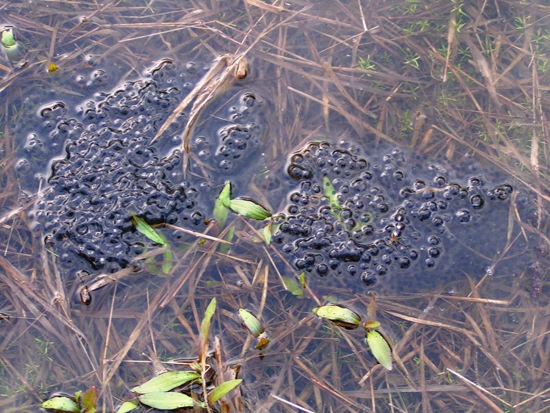
Ranid Eggs by Sara Viernum

Ranid Eggs by Sara Viernum

Brian,

Susan with Frogs Are Green forwarded your e-mail to me.  Roadways are a huge problem for herpetofauna as you’ve found out.  The frogs are mostly likely coming out on the roads during rainy nights to move to breeding grounds or in search of food.  Frogs love rainy nights and move around a lot during them.  Some possible solutions to help save the frogs are to petition the city and or your local Fish and Wildlife/Dept of Natural Resources office to install frog crossing signs and get the speed limit lowered and/or to install fencing that diverts the frogs to an under road crossing (if one is nearby).  If this is a little used road you might asked that it be closed during certain seasons like the famous snake road in the Pine Hills in Southern Illinois that is closed twice a year to allow rattlesnakes to migrate.  Another possibility is to start a citizen group that devotes time to cruising the roads on rainy nights saving the frogs.  I’ve heard of a few areas in the US where people do this.

Thanks for being concerned about the frogs.

Cheers!

Sara Viernum, The Wandering Herpetologist

Spring Peepers by Sara Viernum

Spring Peepers by Sara Viernum

06/25/13

Win win situation for the Hedgehog and for the Frogs in New Zealand

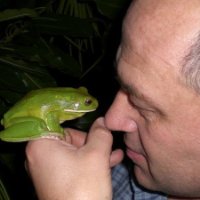
Phil Bishop and frogGuest post by Phil Bishop
acting director at The Centre for Science Communication (University of Otago)
Associate Professor/Chief Scientist ASA


Hedgehogs are cute and cuddly.

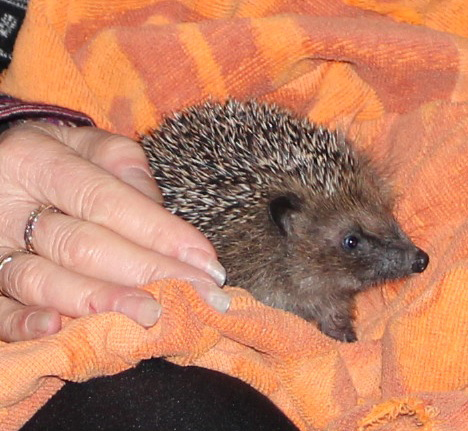
Many children are exposed to characters like Beatrix Potter’s Mrs Tiggy-Winkle, so it was no surprise that when I found a baby hedgehog (called a hoglet) sitting motionless on the sidewalk at 4.30 in the afternoon that I felt moved to help.

This is in New Zealand and many people may not realize that New Zealand was probably one of the last places in the World to be colonized by land mammals.  The only native mammals we have in New Zealand are two species of bats and marine mammals like seals and dolphins.  So all the rats, mice, stoats, weasels, possums and of course, hedgehogs, have all been introduced in the last couple of hundred years.

Hedgehog named Pepper in new zealand

Nearly all the land mammals are introduced species and the native wildlife (birds, reptiles and frogs), who have been happily evolving on their own for the last 80 million years in the absence of mammals, haven’t a clue what to do when they encounter an introduced, vicious, mammalian predator.

I ended up in a dilemma – should I nudge the hedgehog into the oncoming traffic, it was cold and going to die anyway, or should I nurse it back to health and when its old enough, release it back into the wild to wreak havoc with our native wildlife or get squashed on the road as an adult!

The decision was a ‘no brainer’, I couldn’t let this little fellow die a horrible death so I had to rear the little 100 gm orphan.  So now we have a large female hedgehog – a couple of pounds in weight – a vicious predators of my favorite animals that I have been working so hard to save – frogs!  What to do?

Luckily I managed to find someone who was looking for a hedgehog as a pet – so she is now living with a family, never to be released to the wild, never to produce more hedgehogs, never to run the gauntlet of crossing a road but always having her every day needs taken care of.

A win win situation for the hedgehog and for the frogs!

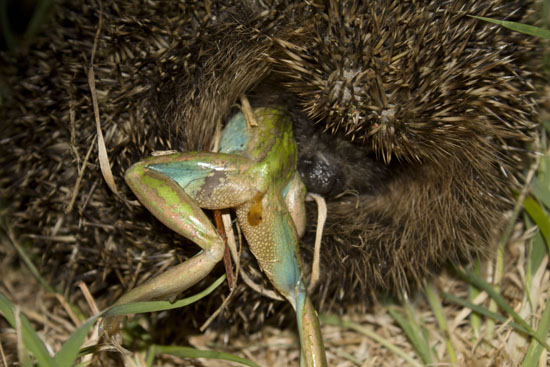
While they might seem cute and cuddly hedgehogs are significant predators of frogs, lizards and even ground nesting birds – and probably play a significant role in the decline of Leiopelma frogs in New Zealand.

frog and hedgehog by Phil Bishop

06/18/13

SALAMANDERS IN CRISIS! An Overview of Why Salamander Conservation is Needed

Guest blog by Matt Ellerbeck, founder of Save the Salamanders

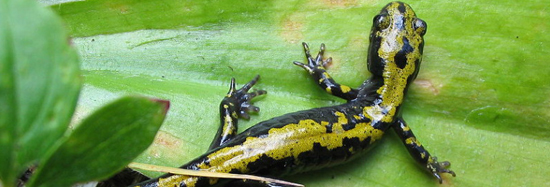
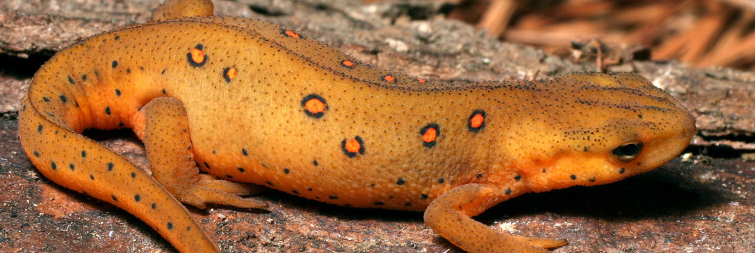
Although they are rarely given much thought, and often overlooked when they are, salamanders are in a terrible crisis. Around half of all the world’s salamander species are listed as threatened by the International Union for Conservation of Nature (IUCN). These species are all facing a high risk of extinction. A further 62 species have been designated as near-threatened with populations rapidly dwindling. This means they are quickly getting closer to threatened status and to the brink of extinction. Sadly for some salamanders it is already too late, as both the Yunnan Lake Newt (Cynops wolterstorffi) and Ainsworth’s Salamander (Plethodon ainsworthi) have already gone extinct.

save the salamanders Salamanders have been on the earth for over 160 million years, and the terrible state that they now find themselves in is due to the detrimental acts of humans. Even those species that are not experiencing population declines deserve attention and conservation to ensure that they remain healthy and stable.

One of the biggest issues affecting salamanders is the loss of their natural habitat. Many areas that were once suitable for salamanders to live in have now been destroyed for developmental construction and agriculture. Habitats of all kinds are being lost at an alarming rate. Wetlands are drained, forests are logged and cut down, and waterfronts are developed. Salamanders are literally losing their homes and they are losing them rapidly. The expansion of urban areas threatens the suitable habitats that still remain.

Where natural habitats do still exist, they are often fragmented or degraded. Fragmentation occurs when healthy areas of habitat are isolated from one another. These fragmented areas are known as habitat islands. Salamander populations are affected since gene flow between the populations is prevented. This increases the occurrence of inbreeding, which results in a decrease in genetic variability and the birthing of weaker individuals.

Fragmented populations where inbreeding occurs often ends in a genetic bottleneck. This is an evolutionary event where a significant percentage of the population or species is killed or otherwise prevented from reproducing. Habitat fragmentation is also harmful because it often eliminates crucial requirements in the area which are critical to the survival of salamander populations. Such areas include spaces that can be utilized for thermoregulation, prey capture, breeding, and over-wintering. Without such habitat requirements populations dwindle.

Breeding sites, often in the forms of vernal pools are particularly important. The loss of such areas in the form of habitat destruction can negatively affect the entire population and its reproductive output. According to the Committee on the Status of Endangered Wildlife in Canada (COSEWIC), there is some evidence that certain salamander species have individuals that return to the pond in which they were born once they reach maturity. Therefore, destruction of a breeding pond may result in loss of the entire population returning to that site. Habitat complexity is also important as it offers shelter to salamanders from both predators and human persecution.

Degradation occurs when the natural habitat has been altered and degraded to such a degree that it is unlikely that any remaining salamanders species would be able to survive. Developments and agriculture near fragmented habitats put salamanders at serious risk. As amphibians, salamanders have extremely absorbent skins. Industrial contaminants, the introduction of sedimentation into waterways, sewage run off, pesticides, oils, and other chemicals and toxic substances from developmental construction sites and human settlements can all be absorbed by salamanders. This can quickly lead to deaths. They can also cause widespread horrific deformities to occur. A study conducted at Purdue University found that out of 2,000 adult and juvenile salamanders 8 percent had visible deformities.

save the salamanders

According to Save The Frogs, Atrazine (perhaps the most commonly used herbicide on the planet, with some 33 million kg being used annually in the US alone) can reduce survivorship in salamanders. Many products are sold with the claim that they are eco-friendly. However, these should be viewed with caution. For example, according to N.C Partners in Amphibian and Reptile Conservation, Roundup and many other surfactant-loaded glyphosate formulations are not labeled for aquatic use. When these formulations are applied to upland sites according to label instructions, the risk to surfactant-sensitive species is considered low. While this may be the case for fish it does not necessarily apply to amphibians. Salamanders that breed in water also routinely use non-aquatic areas and could easily be exposed to glyphosate formulations that contain harmful surfactants through direct application and not just incidental drift.

Habitat destruction and degradation can also effect the availability of prey items, causing unnatural declines in appropriate food sources.

Habitats are often isolated and cut off from one another by the roads and highways that now run through them. Countless numbers of salamanders are killed on roads and highways every year when they are hit by vehicles. Salamanders that are migrating to breeding and egg-laying sites often must cross over roads to reach such areas. Here many of the mature members of the breeding population are killed. Removing members of the breeding populations greatly limits reproductive output, this makes it incredibly hard for salamander numbers to rebound.

Roads present an additional problem because they represent a form of habitat loss. The roads that run through natural areas also fragment the existing populations, drastically making them smaller in size. This limits the gene flow and genetic diversity between the isolated populations on either side and this greatly increases the chances of extirpation. When salamanders attempt to cross roads to travel between the populations, or to critical breeding/birthing sites it greatly increases their chances of being hit and killed by vehicles.

save the salamanders

The Wetlands Ecology and Management (2005) population projections for spotted salamander (Ambystoma maculatum) life tables imply that an annual risk of road mortality for adults of greater then 10% can lead to local population extirpation. Unfortunately, it is estimated that mortality rates can often be as high as 50 to 100%, which means populations are at extreme risk of extirpation and extinction due to road mortality. Wyman (1991) reported average mortality rates of 50.3 to 100% for hundreds of salamanders attempting to cross a paved rural road in New York State, USA. Given that this figure pertains to a rural area from over a decade ago, it is fair to assume that even higher mortality rates occur as their has been in increase in cars and roads over the years. Reducing road mortality is paramount to preserving salamander species.

Being hit and killed by vehicles is not the only threat that roads create for salamanders. Chemical run-off from vehicles contaminate roadside ditches and pools. These sites are often utilized by salamanders for breeding and birthing. According to Steven P. Brady (2012) survival in roadside pools averaged just 56%, as compared to 87% in woodland pools. Thus, an average of 36% fewer individual embryos survived to hatching in roadside versus woodland pools.

Salamanders are also threatened when they are harvested from the wild. Salamanders are taken for the pet trade, for food markets, and for use as fishing bait.

There is much about salamanders that scientists do not know. Aspects of the biology, ecology, and lifestyles of many species is a mystery. This undoubtedly means human interference is negatively affecting salamanders in ways in which we don’t even know. The intricate relation between all species and the vital roles they play within eco-systems is also being altered. Such alterations can have serious consequences to not just salamanders, but many other animals as well (including humans).

To find out how you can help please see: www.savethesalamanders.com

Matt Ellerbeck - Save the Salamanders

About Matt Ellerbeck and Save the Salamanders:

Over the years he has observed hundreds of salamanders in their natural habitats. This interest eventually led to Matt becoming a Salamander Advocate and Conservationist.

Matt also has considerable experience and expertise in regards to salamanders and their care. He has cared for and observed numerous species. These include forms belonging to the genera Plethodon, Ambystoma, Necturus, Notophthalmus, Hypselotriton, Pleurodeles, Taricha, Salamandra, Hemidactylium, Eurycea, Pseudotriton, Amphiuma, Siren, and Paramesotriton. Matt is also in possession of a license to keep Specially Protected Amphibians in Captivity for the purpose of education, which has been granted by the Ontario Ministry of Natural Resources.

Along with wildlife preservation, Matt also believes in the ideals of Environmentalism, Deep Ecology, Biocentrism, Ecocentrism, and anti-Speciesism; and draws from these various movements to help salamanders.

Matt is committed to continuing his efforts to help salamanders. His love and concern for these animals is second to none! 

06/7/13

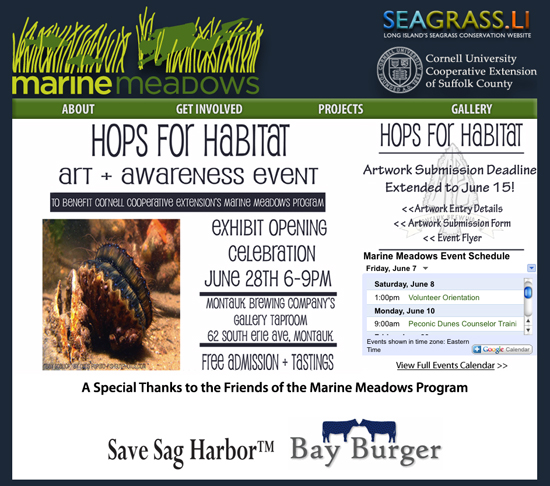
Hops for Habitat in Montauk – Open Call for Artists

OPEN CALL FOR ARTISTS! Cornell Cooperative Extension of Suffolk County (CCE) has been actively involved in the protection and restoration of local eelgrass meadows that are an important habitat for many biologically and economically important species of finfish and shellfish.

To help raise community awareness, they are seeking artist responses to this issue and would like to see works inspired by underwater habitat reflecting the value of our local marine environment during our “Hops for Habitat” art show and sale in Montauk Brewing Company’s Tasting Room from June 28 through July 31, 2013.

Deadline for submissions is June 15.

Please visit www.marinemeadows.com or contact Kimberly Barbour at kp237@cornell.edu for submission information.

hops for habitat art and awareness in montauk

05/2/13

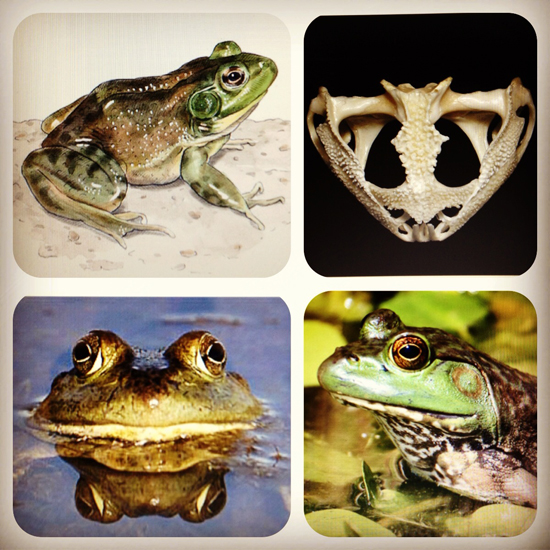
A – Z Frog Species: American Bullfrog (Rana catesbeiana)

american bullfrog
 
Is the most widely spread “true frog” of North America. Found in almost any body of water, they are aggressive predators, consuming everything from plants to small mammals. It is said that if the Bullfrog can shove it in its mouth… it will be eaten! Starting as eggs they go through metamorphosis in 3 months to 3 years depending on climate. Northern specimens taking longer than those in warm southern states. A frog jumping contest favorite, these amphibians can leap as far as 6 feet in a single bound!
 

Coyote Peterson with frog
New series by guest blogger, Coyote Peterson, Coyote Peterson Brands, LLC.